

Food Science & Technology
Episode 2: Could Durian Be the Secret to a Sustainable Future? with Prof. William Chen
Durian is a beloved staple in Singapore, with over 12 million consumed annually. But what happens to the durian seeds and husks after it is consumed? As the nation strives for sustainability and a circular economy, how can we better manage the food waste we generate? Using the King of Fruits as an example, food technologist Prof. William Chen shows us how we can transform trash into treasure, from durian-derived antibacterial bandages, biodegradable food wraps, and natural food stabilisers.
Listen to the Full Episode
Available on: Spotify, Apple Podcasts, and Amazon Music.
Subscribe to Void Deck wherever you get your podcasts to get notified when the next episode drops.
Episode Highlights
-
How scientists are transforming discarded durian husks into unexpected innovations from antimicrobial hydrogel bandages that soothe skin conditions to biodegradable food packaging
-
Why the scale of Singapore's food waste problem – 700,000 tonnes of annual food waste (equivalent to two bowls per person daily) is driving creative solutions in food science and technology
-
The fascinating potential of traditional culinary practices like fermentation in creating a circular food economy
-
How Singapore's unique position as a small, nimble city-state with expertise in biomedical science, AI, and engineering is helping pioneer urban food solutions that could benefit cities worldwide
Timestamps
00:00 Intro
00:46 Upcycling Discarded Durians
06:28 Using Fermentation to Reduce Food Waste
11:12 Singapore's Potential for Food Science & Technology
13:46 Outro
Guest Biography
William Chen received his undergraduate and graduate education from l’Université Catholique de Louvain in Belgium. He is the Michael Fam Endowed Professor and Director of Food Science & Technology Programme at Nanyang Technological University Singapore. He is concurrently Director of Singapore Future Ready Food Safety Hub (FRESH), and also Director of Singapore Agri-food Innovation Lab (SAIL).
Professor Chen is active in securing and leading large competitive research grants from major government agencies as well as leading international food companies. His team’s food technology innovations in food waste upcycling towards the food circular economy have been extensively attracting global attention. In addition to publishing regularly in top food science journals, his team works closely with food industry to translate innovations into consumer products. His team’s food tech innovations and his views on food safety and food security have been regularly featured in major local and international media outlets. He is also advisor/consultant to overseas universities, Singapore government agencies, food industry, and international organizations (ADB, FAO, WEF, WHO among others).
Transcript
This transcript has been lightly edited for clarity and readability.
JANICE: This is Void Deck, a podcast from Science Centre Singapore where we sit down with local STEM changemakers and explore science happening right here in Singapore. I'm your host, Janice. Today, we're asking: could durian be the secret to a sustainable future? Scientists in Singapore have transformed the leftover seeds and skins of the iconic King of Fruits into antibacterial bandages, biodegradable food wraps and natural food stabilisers, and here to tell us more is food technologist Prof. William Chen. Prof. Chen is the Michael Fam Endowed Professor and Director of the Food Science & Technology Programme at Nanyang Technological University.
[Upbeat intro music]
JANICE: Thank you so much for coming on to the show.
PROF. CHEN: Thank you for having me here.
JANICE: How did you first become interested in durian?
PROF. CHEN: Well, as our focus [at NTU Food Science & Technology Programme] is on reducing food waste, we have developed a number of platform technologies, and one of them is actually to convert the solid residues rich in fibre into biodegradable packaging materials. These include the soybean residue (okara, in other terms) and the barley spent grain.
All these side-streams from the food processing industry are rich in cellulose. So we have developed technology to convert these fibre-rich side-streams into packaging materials. And since I mentioned this is a platform technology, so we also apply to other fibre-rich side-streams, and durian husk is one of those.
JANICE: Okay, so the reason why you got interested in durian is because of [its] fibre-rich properties as a byproduct?
PROF. CHEN: Yeah, well, when we design our innovations, we do not do it on the random basis. So first we analyse the composition of these materials, and then we design strategy to upcycle these side-streams.
In other words, people call them “waste-to-be”, but we see value in these side-streams because they are either nutrient-rich or fibre-rich, and we can talk about nutrient rich-side of the story later on, but even when we talk about durian husk, they are very rich in fibre and pectin and some other materials.
But our technology platforms can be easily applied to convert the fibre-rich part of the durian husk into biodegradable packaging materials.
JANICE: Awesome. Most people wouldn't think of durian as the fruit that will be upcycled, you know, because of the way it looks, it's very big, it’s very bulky, it's very spiky, and of course it has that infamous strong smell.
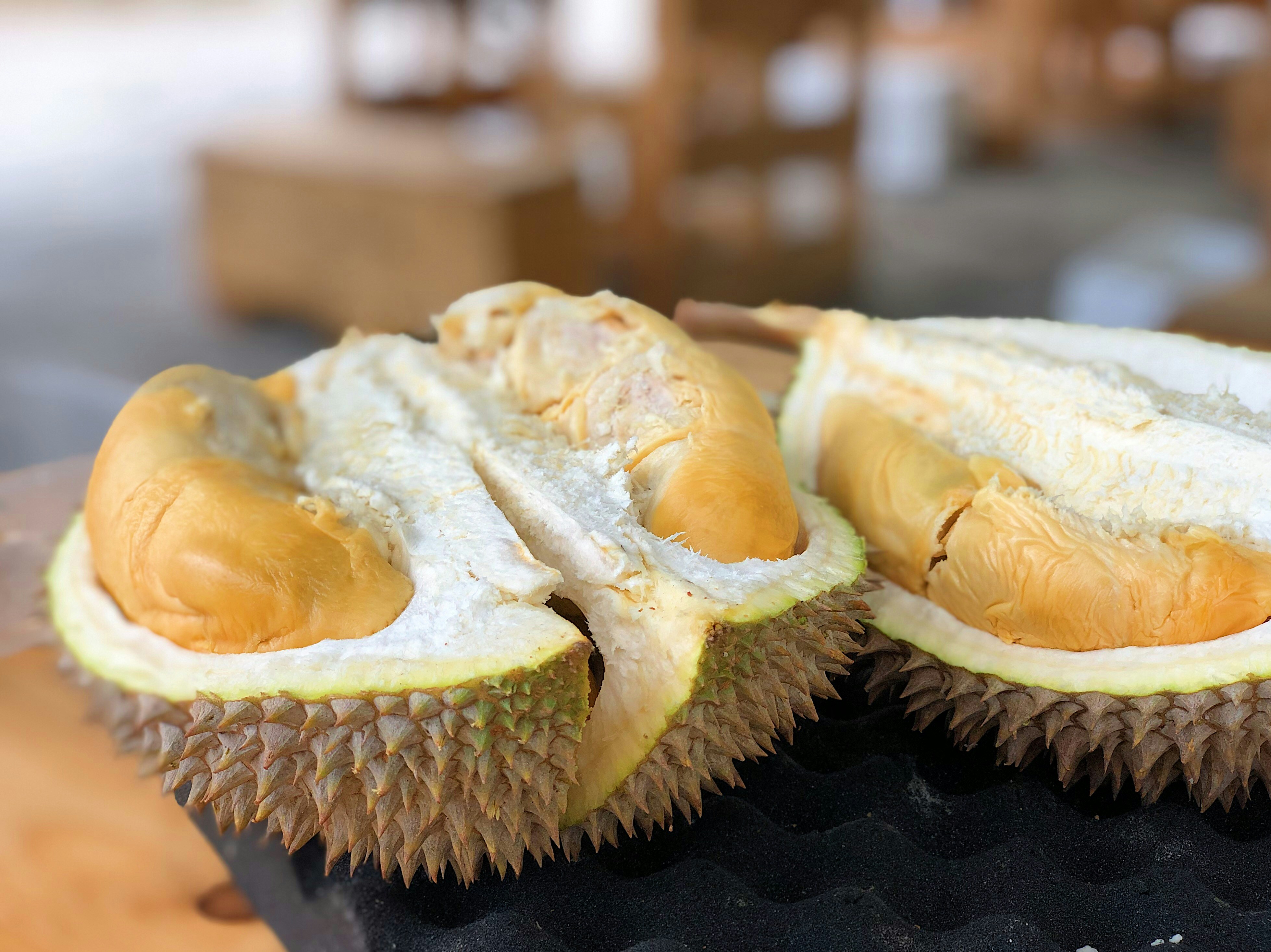
Close-up of opened durian fruit. Source: Jim Teo/Unsplash
So what made you realise its potential for food science innovations?
PROF. CHEN: Well, in Singapore, as we know, we generate about 700,000 tonnes of food waste every year. In other words, it's about two bowls of food waste generated per person per day.
JANICE: Wow.
PROF. CHEN: And reducing food waste is actually one of the very important aspects of creating an efficient food system. For example, if we can tackle this homogeneous side-streams, we can also look into tackling the heterogeneous household food waste, but for the durian part, we know that when you open up the durian, there's only that much or that little you can eat.
JANICE: [Laughs] Yes!
PROF. CHEN: The rest, you just throw them away. So we look at the two aspects of this side-stream from durian. One is the husk. The other one is the seed. So for the husk, we have mentioned that we can convert them into biodegradable packaging material and also the bandages, and for the seeds we also have developed this food stabiliser, which really provides a cost-effective way to enhance the current food system.
JANICE: Let's delve a little deeper about the durian husk. In basic terms for listeners who aren't scientists, how would you transform the husk into a clean antibacterial bandage?
PROF. CHEN: When we look at the cellulose, right, you know, which is abundant in this husk, what we do is we first extract the cellulose using very simple technology. We do not generate the secondary organic waste.
Instead, we use this very simple solution to convert this cellulose into a transparent, translucent type of material that can be used either in packaging material or other applications. In the case of bandages, we actually cross-link these materials so that it will become a different material.
We call it hydrogel, and from the hydrogel we actually add a little bit [of] the antimicrobial component, and then the bandages will become antimicrobial bandages derived from durian husk, but has a wide application in term of healthcare, you know, for individuals who may have a skin problem, a typical skin problem we call acne, right, or very dry skin.
If you apply the common bandage, it's not moist, so it doesn't really help them, whereas our moist hydrogel antimicrobial bandages actually relieve this sensation of itchiness and also provide[s] this protection against bacterial infection.
CNA segment featuring Prof. William Chen explaining how he developed antibacterial bandages from durian husks.
[Short musical transition]
JANICE: What are some things the public may be surprised to know about the processes involved in your research, for example, your day-to-day operations, or how food scraps are being sourced? Are there any interesting thing[s] about this process?
PROF. CHEN: Well, if we talk about platform technologies or technology platforms, we can talk about this cellulose extraction into packaging materials. Another technology platform we have developed is actually fermentation. I see this really as an anchor to solve a number of problems in food waste reduction.
One of them is actually spoilage of side-streams like soybean residue, barley spent grain being derived from making beer or making Milo. These side-streams tend to be very rich in nutrient[s], which make them turn bad very fast.
So by applying fermentation using good microbe (good microbe meaning the probiotic or other type of beneficial microbes) we actually stop the spoilage. Because it's like our gut. People, when they are healthy, they tend to be less prone to food poisoning because the good microbe[s] occupy all the space.
In the same line of thinking, when we give this side-stream to the good microbe, they took up all the space so that the contaminating microbe [have] no space to settle down and turn this nutrient-rich side-stream bad. So this is what we have discovered when we apply the simple technology [of] fermentation.
Fermentation, as the general public knows, has been widely applied in our daily life. We talk about kimchi. We talk about miso. All these are good example of food product[s] derived from fermentation. Or natto, right.
So when we apply fermentation technology to [these] nutrient-rich side-streams, we stop the spoilage. At the same time, the good microbe produce[s] micronutrients to make this final product even more nutritious.
In term of nutrition profile, there are two categories of nutrient. One is called macronutrients. The other one is micronutrients. Macronutrients will include protein, lipid, carbohydrate, whereas micronutrients will include vitamin, antioxidant, short chain fatty acid.
So fermentation, the microbe will produce this micronutrients, and reach this fermented product. And so we have demonstrated that this fermented soybean residue can actually loop back to the current food system. For example, we have produced a plant-based mayonnaise which has been reported by The Straits Times before using this technology.
And when I talk about this fermentation as a platform technology, it's not simply about soybean residue or barley spent grain. In fact, we apply the fermentation technology to convert the prawn shells into packaging materials.
And what happened to the so-called nutrient rich solution from this fermentation of such prawn shells? Well, we reconnect [it] back to the urban farming, which is very important for Singapore's sustainable food security, so this will become fertiliser for the urban farm.
JANICE: That’s good. So it's a very closed loop way of doing it.
PROF. CHEN: Correct, exactly. What we aim is always to create efficient food system that allows the minimum level of generation of food waste, while maximising some of the food waste that we cannot avoid. For example, as long as we eat bean curd, as long as we drink soy milk, we will have this soybean residue.
JANICE: Okara.
PROF. CHEN: Yeah. So as long as people keep on drinking beer, [we’ll] always have a barley spent grain. So these type of side-streams would be important for us to find ways to either convert them into useful materials or connect back to the food system.
But in any case, we should not leave it as a waste because they are still very rich in useful component[s]. So our technology allows us to create this full circular economy, which is very important for Singapore, because we import 90 percent of the food into the country.
And the food waste is the last thing we want to see in large amount, because they pollute the environment, you waste [it], you increase the burden of government for food import, and so on.
JANICE: We are very grateful for you and your team's effort and dedication to helping create this more sustainable food cycle for all of us. With that, moving on to our next question, you've lived and work around the world researching about food science and technology. Why is Singapore an exciting place for this field?
PROF. CHEN: Well, if we look at Singapore, it's a small city state well-known for high efficiency, and it has been recognised as a one of the bright spot[s] globally for innovations.
In the case of food science and technology, it's using food science and technology to create this efficient food system. [Being] small make[s] us nimble and get[s] things [moving] fast. But that's only one part of the perspective.
The other part, more importantly, is the need to develop urban solution[s] for our food security. When we talk about urban solutions, people may say, oh, that's because you don't have enough farmland, but I see things differently, because it was estimated that by 2050, 70 percent of the world population will live in urban areas.
We look at Singapore [as] a hub for biomedical science, R&D, for AI, for engineering, for the pharmaceutical industry as well. All these existing expertise can be [and] are being translated into the food space. There are a lot of existing expertise in Singapore that can be translated with the correct tweaking, you know, to suit the food. The requirement can be translated into the food space so that we can move very fast.
So therefore we are always well recognised globally. As you mentioned, I work quite a fair bit with international organisations. We have been invited by institutions like the World Health Organisation (WHO) [and] Food and Agriculture Organisations (FAO) of the United Nations to work on policy matters. And also, innovations developed in Singapore, through working with these international institutions, we can achieve faster and broader adoption because [this is] truly standardisation, harmonisation with WHO and FAO.
I think we can see that the technology made in Singapore will have a wider adoption and create real impact, not just for Singapore, but also beyond.
[Outro music]
JANICE: Special thanks to Prof. Chen for coming on the show, and thank you, our listeners, for tuning in and supporting Singapore science. If you enjoyed this episode, please rate and subscribe wherever you get your podcasts. Craving more local science stories? Read more features and listen to past episodes at voiddeck.science.edu.sg. See you next time!
Resources
Prof. William Chen's Website
https://www3.ntu.edu.sg/home/WNChen/William_Home.htm
Food Science and Technology Programme at Nanyang Technological University
(NTU)
https://www.ntu.edu.sg/cceb/fst
Singapore Future Ready Food Safety Hub (FRESH)
https://www.ntu.edu.sg/fresh
Singapore Agri-food Innovation Lab (SAIL)
https://sg.linkedin.com/company/sail-agrilab
Cui X, Lee J, Ng KR, Chen W (2021) Food waste Durian rind-derived cellulose organohydrogels: toward anti-freezing and antimicrobial wound dressing. ACS Sustainable Chem. Eng. 9, 3, 1304–1312 (IF: 7.6) https://pubs.acs.org/doi/10.1021/acssuschemeng.0c07705
Zhao G, Lee J, Cui X, Chen W (2019) Biodegradable and transparent cellulose film prepared eco-friendly from durian rinds for packaging application. Food Packaging and Shelf Life, 21, 100345, https://doi.org/10.1016/j.fpsl.2019.100345.
Lee J, Zhao G, Kim J, Castillo-Zacarias C, Parra R, Chen W (2018) Dual
use of a biopolymer from durian (durio zibethinus) seed as a nutrient source
and stabilizer for spray dried Lactobacillus plantarum. Frontiers in Sustainable
Food Systems,
https://doi.org/10.3389/fsufs.2018.00053.
Scientists at NTU turn durian seeds into food stabiliser and probiotics
https://www.straitstimes.com/singapore/scientists-at-ntu-turn-durian-seeds-into-food-stabiliser-with-probiotics
NTU team uses durian husks to make bandages for post-surgery
https://www.straitstimes.com/singapore/ntu-team-uses-durian-husks-to-make-bandages-for-post-surgery
Teng TS, Chin YL, Chai KF, Chen W (2021). Fermentation for future food
systems. EMBO Reports, 22(5):e52680
https://doi.org/10.15252/embr.202152680
NTU scientists develop plant-based ingredient to replace eggs and dairy
in mayonnaise
https://www.straitstimes.com/singapore/ntu-scientists-develop-plant-based-ingredient-to-replace-eggs-and-dairy-in-mayonnaise
Sustainable antibacterial food wrap that changes colour when food goes
bad
https://www.ntu.edu.sg/news/detail/sustainable-antibacterial-food-wrap-that-changes-colour-when-food-goes-bad
Want to learn more about sustainability? Check out the following exhibitions at Science Centre Singapore and get your tickets at https://www.science.edu.sg/buy-tickets :
Climate Changed Exhibition
https://www.science.edu.sg/whats-on/exhibitions/climate-changed
Credits
Special thanks to Prof. William Chen for coming on the show. This episode of Void Deck was hosted by Janice Tow. The episode and series was produced by Jamie Uy. Audio engineering and pre-production research were provided by Ewan Leong. Video teasers were edited by Lydia Konig. Studio production was assisted by Jane Stephanie Emmanuella and Ai Xin Qin. Season 2 music and graphics were created by Ai Xin Qin. The cover art was illustrated by Vikki Li Qi. The Void Deck podcast is an original transmedia production by Science Centre Singapore.
Last updated 4 December 2025