

Ecology
Episode 4: Are Our Heritage Trees Actually Non-Native? with Dr. Shawn Lum
Scattered across Singapore are 255 registered Heritage Trees—remarkable for their majesty, cultural value, and the histories these green landmarks are rooted in. While some are native, many aren’t. So how did our heritage trees end up here, and what makes them worth conserving? In this episode, tropical forest ecologist Dr. Shawn Lum walks us through the hidden world of our heritage trees, the work that goes into conserving them, and why they matter more than we might think.
Listen to the Full Episode
Available on: Spotify, Apple Podcasts , and Amazon Music.
Subscribe to Void Deck wherever you get your podcasts to get notified when the next episode drops.
Episode Highlights
-
The meaning behind Heritage Tree status - how trees earn this prestigious designation through their botanical value and cultural significance
-
The extensive work that goes into conserving our natural heritage, from expert arborist inspections to lightning protection installation
-
The journey of Singapore's most common Heritage Tree species, the Rain Tree, from South America to Southeast Asia
-
Discovering century-old majestic trees in the Changi area that still stand as living witnesses to Singapore's changing landscape
-
How everyday citizens can contribute to forest conservation, from nominating potential Heritage Trees to participating in the One Million Trees movement
Timestamps
00:00 Intro
00:59 Definition and Criteria for Heritage Trees
02:29 Nomination Process for Heritage Trees
04:27 Non-Native Species and Globalisation
07:34 Maintenance of Heritage Trees
10:44 Dr. Lum’s Favourite Heritage Trees
13:44 What You Can Do to Help Our Forests
15:14 Outro
Guest Biography
Dr. Shawn Lum joined the NTU Asian School of the Environment in January 2016 after spending more than twenty years as a Lecturer at the National Institute of Education. He joined NIE upon completion of his PhD at the University of California, Berkeley. Shawn is a product of islands - he was born in Tokyo, raised in Honolulu, and has spent his working career in Singapore. Shawn's teaching has centered upon plant diversity, forest ecology, and conservation. In addition to his teaching and academic work, he works closely with local environment and nature-related agencies and is also active in nature conservation NGOs and civil society. [From NTU ]
Transcript
This transcript has been lightly edited for clarity and readability.
JANICE: From Science Centre Singapore, this is Void Deck, a podcast where we explore the universe from the heartlands together with STEM changemakers. I'm your host, Janice. Scattered across Singapore are 255 registered heritage trees [editor’s note: updated as of 1 June 2025], remarkable for their age, size, and unique histories. While these trees are important landmarks of our green city, some aren't originally from Singapore. So today we're asking: are our heritage trees actually non-native? To learn more, we talked with tropical forest ecologist Dr. Shawn Lum.
[Short musical interlude]
JANICE: Welcome to the show, Dr. Lum.
DR. LUM: Janice, thank you very much. Delighted to be here.
JANICE: Would you like to give a quick introduction about yourself to our listeners?
DR. LUM: I'm Shawn Lum, I'm a tropical forest ecologist. I teach at the NTU Asian School of the Environment. Been there for the past ten years and before that, about twenty years at the National Institute of Education (NIE) in the Biology Group.
JANICE: So as someone who works closely with Singapore's natural environments, could you help our listeners better understand what exactly is a heritage tree and what makes these trees different from the ones we see every other day?
DR. LUM: Heritage trees in one sense aren't any different from other trees that we see, except they've maybe reached some exceptionally majestic size or have quite a bit of historic or cultural value.
There are these programs in cities all around the world called exceptional trees, champion trees, you know, so on, and the Heritage Tree scheme was introduced by the National Parks Board (NParks) about twenty-five years ago. The intention was to really highlight trees of exceptional majesty or beauty. And so there are a few criteria. There's a minimum size, basically [a] circumference of five metres.
In some cases, some species just don't grow that large. So if a tree doesn't meet that minimum criteria, the alternative is to have an exceptional size for that species. And then there'll be other considerations like, does it have maybe some particular value for that place or the people associated with that tree that might add to its heritage status.
And then once it's nominated, then a panel of experts from NParks and outside, then we'll evaluate that tree and make sure that not only does it meet [the] criteria for size and it's healthy and so on, but it also has a pretty good future. In other words, there are no impending plans to clear that area for development projects, for example.
JANICE: Awesome, so I think you mentioned having a Heritage Tree Panel , right?
DR. LUM: Yes.
JANICE: So being one of the representative[s] on that panel, how do you and the rest of the panel decide, or rather, [what] do you look out for when you're deciding what trees deserve that title? Can you walk us through that process?
DR. LUM: It’s a fairly well practised drill at this point. We meet once a year to go through nominees that have been not only nominated, but screened by a team of arborists from NParks. When we first started the scheme in the early 2000s, there was kind of [a] flurry of nominations and anyone could nominate. Janice, you could nominate a Heritage Tree, you know, so I'm holding [you] to it.
JANICE: Awesome, good to hear that anyone can nominate [these] trees.
DR. LUM: In fact, people are encouraged. I think the idea really isn't just to highlight trees of exceptional size, although that would be the criteria. I mean, you're in the science communication field, you've heard of this condition called plant blindness, where basically you see the plants, but you actually don't see them. You don't really notice them other than being part of the background.
[Editor’s note: To combat plant blindness, read this related Void Deck article titled “A Guide to Singapore’s Street Trees” and try going on a short stroll around your neighbourhood to notice the trees nearest to you!]
I think the idea of the Heritage Tree Scheme, as well as similar schemes all around the world, is really to not just celebrate trees, but to encourage people to take notice of them, to develop a relationship with them, to maybe even have their own favourite tree. And even if it doesn't have heritage status in a formal sense, it doesn't make it any less valuable to the individual person who finds beauty and meaning, and maybe some sort of solace in getting to know a tree, an individual tree better.
JANICE: I love that. Really teaching everyone to slow down, you know, appreciate the trees that are around you.
DR. LUM: Yeah, they're remarkable things. And if you could think of, you know, consider what a tree might have seen, especially in a place like Singapore, where the landscape changes so quickly. Imagine the life of a tree, if it could share with you what it has witnessed, the people it's seen, and the various cultural and landscape changes--it'd be quite a story.
[Short musical transition]
JANICE: One species that stands out as the most represented [tree species] in the Heritage Tree Register is the magnificent Rain Tree, also known as Samanea saman, if I'm pronouncing that correctly.
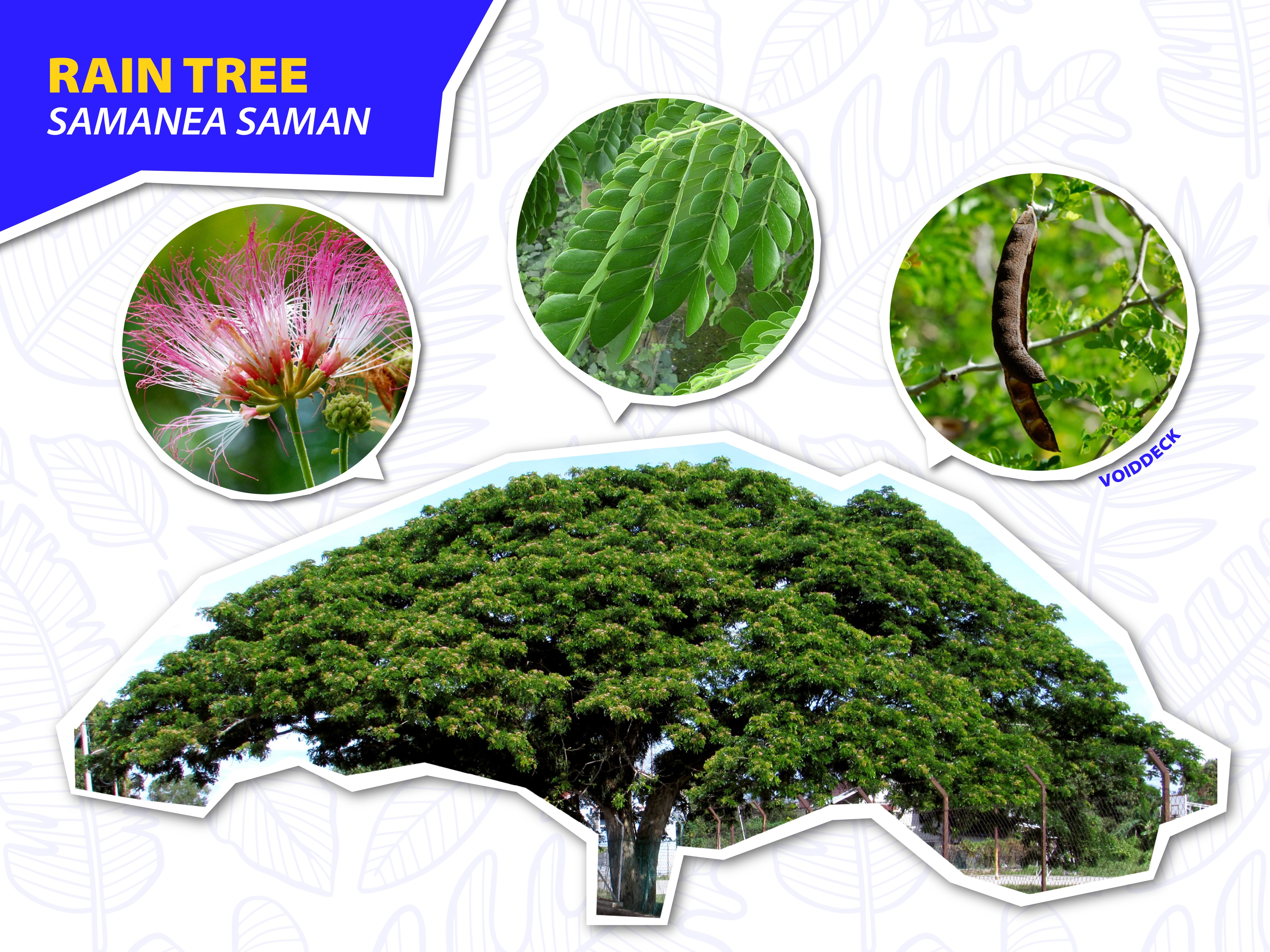
Infographic showing the large, umbrella-shaped crown of the rain tree along with its powderpuff flowers, leaves, and seedpods. Graphic credit: Jansen Michelle/Void Deck.
DR. LUM: I couldn't do it better myself, Janice.
JANICE: Awesome. Now, these umbrella shaped giants are sprinkled all over Singapore, but many might be surprised to learn that they are not originally from here. So could you share how this South American species ended up in our city?
DR. LUM: Sure, yeah. It's of course a ubiquitous tree. It provides beautiful shade. It's a hardy species, easily transplanted, easily propagated. It has a lot going for it, and it might be that some individual trees are nominated as heritage trees, and there are those, for example, that line the Padang—that whole cluster together has been nominated.
If you think about it, plants have perhaps been the earliest examples of globalisation. I'll talk about trees in a second, the rain tree in particular, but if you think about the plants that have transformed the way we live, I mean, just think of our diet in Singapore. How often do we eat tomato or potato or chilli?
JANICE: Daily.
DR. LUM: Right, and it's such an integral part of our cuisines, but then if you think about it, the potatoes [are] from South America, tomatoes from South America, corn is from Central America and Mexico, chilies are from Central America and Mexico, so they've been globalised long before.
In fact, people think of it as an indigenous part of our culture, so plants have been everywhere and impacting societies for centuries ever since, well, European explorers started circling and circumnavigating the globe and bringing things back to and moving things across around the world. So the same with the rain tree.
It's from Central America. Just think about it. That was part of the big, the great Spanish Empire, and I've looked into this, and it seems as if the earliest introduction of rain tree to Asia, tropical Asia, was to the Philippines, which was also a Spanish colony. And then from there, the virtues of the rain tree must not have been unnoticed because they got spread around.
And the records show that [the] rain tree was introduced to Malaya, British Malaya, in the 1870s, so about, half a century after they were brought to Asia, and if you go to tropical cities all around the world, there is a kind of a common, almost global community of trees in our cities, so rain tree could be one. Our Angsana is a contribution to the wider world, because that's planted all over the tropics, something like trumpet tree, all of these make up, are a set of species whose properties are well appreciated.
They're hardy, easy to propagate, they're beautiful, and they really have become internationalised, so even though they're not really native, I would still say they are a traditional part of the tropical landscape, including Singapore, you know. In the same way that, you know, chilli, and all of these, we adopt them as our own, they're not seen as expat food items. They are ours. And the same thing could be said for some of these heritage trees like rain tree.
[Short musical transition]
JANICE: Given how special and prominent these heritage trees are in Singapore, I would imagine looking after them requires a lot of attention. Could you share with us what actually goes into [caring for] and maintaining a heritage tree?
DR. LUM: So first of all, before becoming a heritage tree – and this is where all the pre-screening takes place – a team of expert arborists from NParks will visually inspect the tree to make sure it's healthy. They'll then subject it to all kinds of tests. Is it hollow in the inside? Are there any signs of fungal rot that might prematurely end the life of this tree? Its shape. Has it been well managed in the past? In other words, they want to know not only does it look beautiful now, but will it continue to grow healthily and happily in the decades ahead?
So then, all heritage trees, once approved, they also have to have the consent of either the landowner, in which case many of them are, of course, on in parks or nature areas, so that would come under the purview of NParks, but in other cases they might be on private land.
And heritage trees are outfitted with lightning protection. So if you look at a heritage tree, you see a copper cable running down the side. That's because there's a lightning rod up at the top of it. You have to pay for somebody to climb that tree, install the lightning protection, and so on, so it's not a trivial amount of work or money that goes into--
JANICE: Taking care of this.
DR. LUM: Well, taking care of and designating a tree as a heritage tree, and then there's the maintenance that has to follow. So again, is it healthy? Is the landowner willing to pay for the lightning protection and the continued maintenance under a kind of prescribed maintenance regime? You know, like a health check that you and I would go to regularly.
And I mean, one of the other things is to also make sure that there are no impending development plans for that area. So to nominate a heritage tree and go through all of that, only to find that this tree has to make way for an important infrastructure project in a few years’ time--that doesn't happen. No, we try to avoid that at all costs. So a lot of these nominees are put on a reserve list until the long-term status of that area is sorted out.
JANICE: Okay, interesting. I didn't think that you guys would actually think that far ahead as to considering the construction, upcoming projects.
DR. LUM: Yes, well, if I could add, Janice, if you think of it, so you and I, everybody here in the studio, we could each take part in one of those One Million Tree tree plantings. It's a little sapling, no bigger than around, say, your thumb. And who knows, thirty years, fifty years, hundred years from now, that tree could grow into that five-metre size class and qualify to be a heritage tree.
Nobody who ever planted some of these would have ever imagined that some of these trees would become so majestic and beautiful and bring shade and hope to people who walk under its shade everyday, but they do become heritage trees. I think whenever you work with things that have such a long lifespan, I think you can't help but think ahead. You have to, because these trees will long outlast, outlive the people who planted them and named them heritage trees in the first place.
[Short musical transition]
JANICE: After all of your years here working with Singapore's magnificent trees, do you have a favourite heritage tree, and if so, where can we find it in Singapore, and what's the story behind it?
DR. LUM: I love them all, but there's one in particular that I--
JANICE: It's a favourite.
DR. LUM: It's a, well, it's one that I look out for every time I pass by it.
JANICE: Aww.
DR. LUM: So if you’re familiar with Changi Village, there's a road there called Cranwell Road that comes off of Loyang Avenue. And that leads into another street called Netheravon Road, and Netheravon will bring you right to the Changi Village Hawker Market from the other side.
That Changi Village area used to be a forest reserve. It was called, well, the Changi Forest Reserve, and it was designated as such by the colonial government at the time, but then the protected status was lifted when the British decided to turn Changi into a military area.
And so that forest reserve was cleared, but there were a few trees that were left in the landscape because I guess they weren't directly in the way of any kind of building or other development. So there were about a dozen trees that were designated as heritage trees that were leftovers from this Changi Forest Reserve. These are giant rainforest species that are extremely rare, rare even in our nature reserves like Bukit Timah, or the Central Catchment, so that there— [pauses] I should have made it clear, there are two, three [trees] that I particularly look [for].
JANICE: Okay, it's increasing, it's increasing. [Laughs]
DR. LUM: But maybe the most favourite is [the] one on Netheravon Road. It's a species of Shorea, one of these large Meranti trees in the rainforest. It's called Shorea gibbosa [editor’s note: the updated scientific name for this species is Richetia gibbosa], and now the local name escapes me for the moment [editor’s note: the local name is Damar Hitam Gajah], but what's remarkable is this tree is probably at least 300 years old.
JANICE: Woah.
DR. LUM: It's right next to a bus stop on Netheravon Road, and it commands the highest point on the little bluff that overlooks the coast.
Magnificent, magnificent tree, and I guess the added kind of beauty of it for me, or the irony is that it's been around for so long, so few people notice it. I look out for people who sit at that bus stop waiting for their number 19 or 29, or whatever bus, and nobody really looks at that tree that much. I think it's such a shame it, like I said, imagine what it's seen in its three to 400 years of, you know, being around.
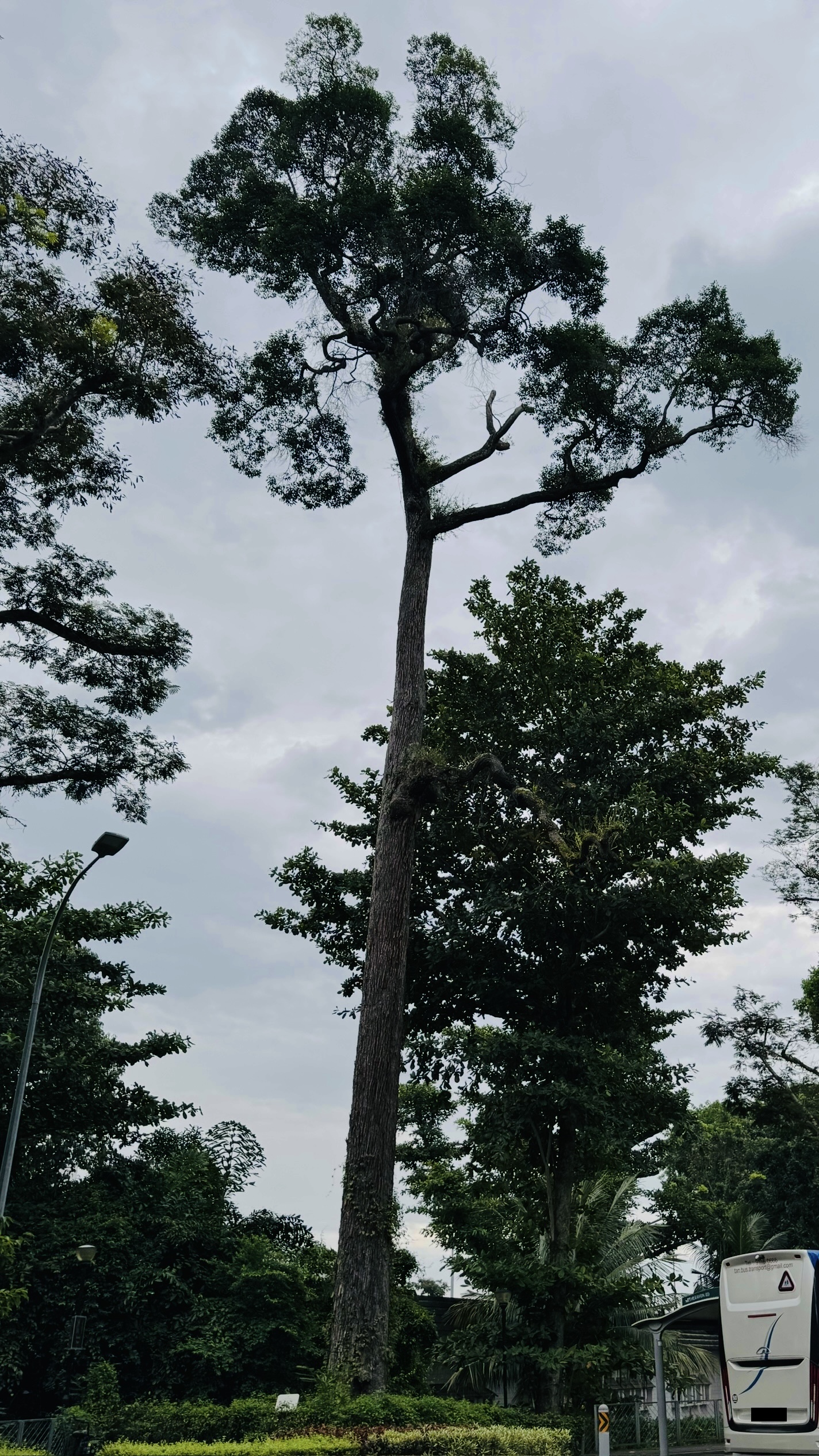
Damar Hitam Gajah (HT 2003 113) in the Heritage Tree Register located in Changi along Netheravon Road near Bus Stop 99091. Photo Credit: Jamie Uy
There are two other trees that I really do like to look out for in that area. One is closer to Loyang Avenue, another giant rainforest species called Dipterocarpus sublamellatus. That's a big mouthful of a name, but again, it's something that's so rare in our rainforest, and there's one right in the middle of, at the entrance to Changi Village, which nobody really notices, sadly.
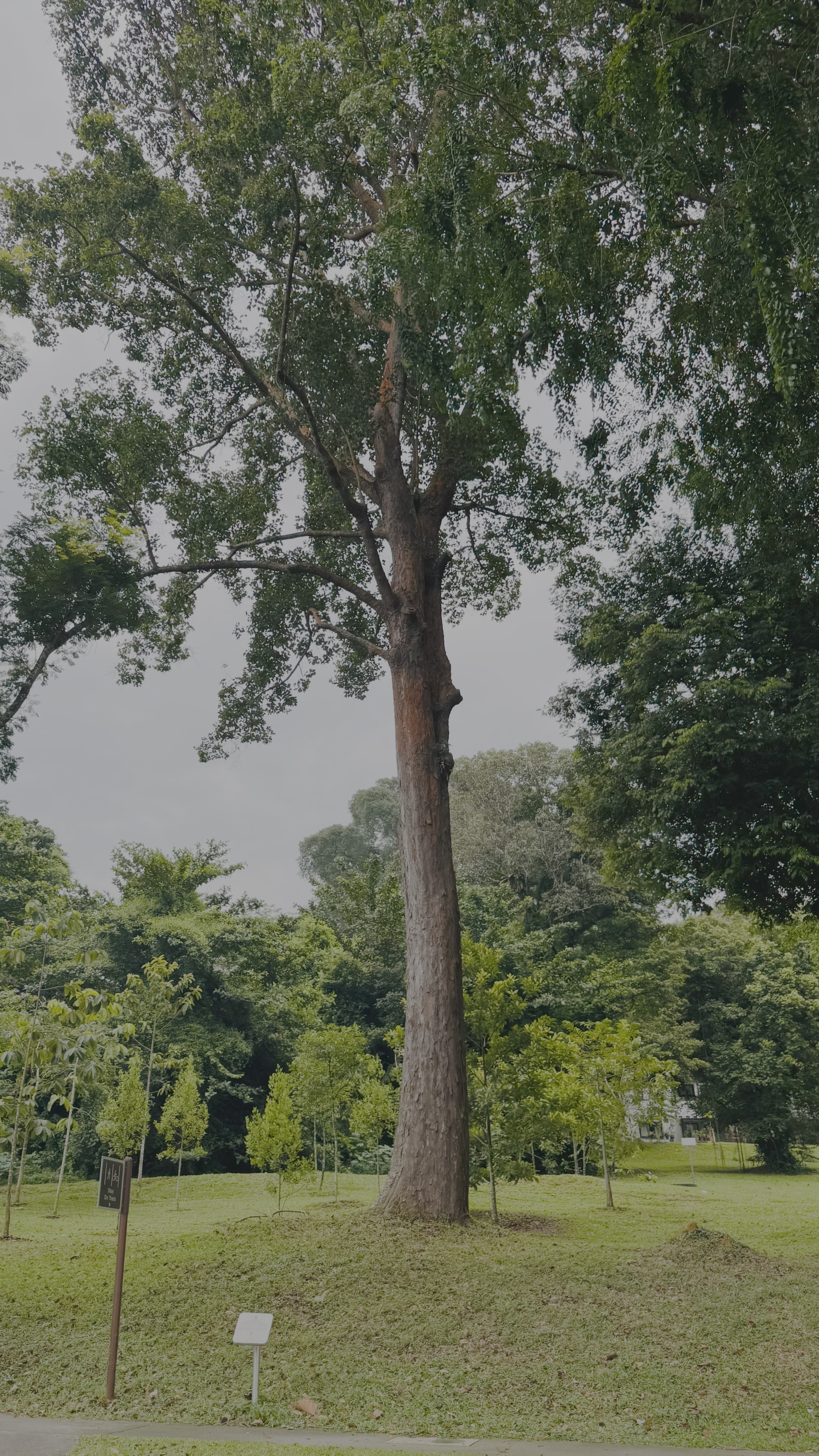
Keruing Kerut (HT 2003 49) in the Heritage Tree Register located in Changi along Cranwell Road near junction with Loyang Avenue. Photo Credit: Jamie Uy.
JANICE: It's okay, with this podcast [out]: everyone, drop by Changi Village, look out for these trees.
DR. LUM: Yeah, but don't trample on its roots and stress it out, right. But yeah, it's part of our heritage, as much a part of our heritage as a beloved building or a temple or a church.
[Editor's Note: Eager to explore the heritage trees in the Changi area? Grab your walking shoes and follow this DIY trail map and guide from NParks to see Dr. Lum's favourite trees in person and spot other nearby green landmarks.]
[Short musical interlude]
JANICE: Dr. Shawn, to wrap this session up, what's one thing that anyone, especially those of us without a green thumb, can do to protect our forest?
DR. LUM: Well, okay, [a] number of things. There’s technical things you can do, right, or financial contributions you can make, whether to an NGO, to the National Parks Garden City Fund. Sign up for a tree planting exercise as part of the One Million Trees Movement.
So many things, but I think, ultimately, to say, take care of our forests, and sort of by association, every forest in the world--that's a lifestyle thing, isn't it, to be enlightened and sensitive consumers. That we don't take more than what we need, that we try to support the people and communities and companies who are striving to manage the landscape in a sustainable, nature-friendly way.
And ultimately, maybe this brings us back full circle, Janice, all that starts, I believe, by just building a relationship with a tree. Getting to know it, and that I think becomes the passport to this big, wild, miraculous world of nature. And so I won't say go out and hug a tree, although it is a nice, wonderful feeling, thing to do, but yeah, take a look at a tree, observe it, get to know it, and you'll be amazed at how much your life will be enriched by that experience.
[Short musical interlude]
JANICE: Special thanks to Dr. Shawn Lum for coming on the show. To learn more about the environment, check out Science Centre Singapore’s exhibitions like Earth Alive and Climate Changed. If you enjoyed this episode, please rate and subscribe wherever you get your podcasts. You can find the episode transcript, show notes, and more resources at voiddeck.science.edu.sg/podcast. Thank you for listening to Void Deck. Stay curious!
Resources
Dr. Shawn Lum's Faculty Profile at NTU Asian School of the Environment
https://dr.ntu.edu.sg/entities/person/Shawn-Kaihekulani-Yamauchi-Lum
About Heritage Trees | National Parks Board Singapore
https://heritagetrees.nparks.gov.sg/heritage-tree-scheme/
Heritage Tree Register | National Parks Board Singapore
https://heritagetrees.nparks.gov.sg/heritage-tree-register/
Nominate a Heritage Tree | National Parks Board Singapore
https://heritagetrees.nparks.gov.sg/nominate-tree/
Heritage Tree Care Guide
https://file.go.gov.sg/heritagetreecareguide.pdf
Did You Know? | Heritage Tree Scheme
https://heritagetrees.nparks.gov.sg/did-you-know/
Why 'plant blindness' matters — and what you can do about it | BBC
https://www.bbc.com/future/article/20190425-plant-blindness-what-we-lose-with-nature-deficit-disorder
Pterocarpus indicus Willd. (common name: Angsana) | NParks Flora and Fauna
Web
https://www.nparks.gov.sg/florafaunaweb/flora/3/0/3093
A Guide to Singapore's Street Trees | Void Deck
https://voiddeck.science.edu.sg/sg-trees/
Samanea saman | NParks Flora and Fauna Web
https://www.nparks.gov.sg/florafaunaweb/flora/3/1/3106
Rain Trees of Connaught Drive | National Parks Board
https://heritagetrees.nparks.gov.sg/ht-2015-255/
Damar Hitam Gajah (HT 2003 113) | Heritage Trees Register
https://heritagetrees.nparks.gov.sg/ht-2003-113/
Keruing Kerut (HT 2003 49) | Heritage Trees Register
https://heritagetrees.nparks.gov.sg/ht-2003-49/
Dipterocarpus sublamellatus Foxw. | NParks Flora & Fauna Web
https://www.nparks.gov.sg/florafaunaweb/flora/3/9/3963
DIY Heritage Tree Walking Trail Guides | National Parks Board Singapore
https://heritagetrees.nparks.gov.sg/trail-guides/
OneMillionTrees Planting Activities
https://www.nparks.gov.sg/treessg/one-million-trees-movement/upcoming-activities
OneMillionTrees Movement
https://www.nparks.gov.sg/treessg/one-million-trees-movement/about-the-movement
Want to learn more about environmental science and sustainability? Check out the following exhibitions exploring environmental issues at Science Centre Singapore and get your tickets at https://tickets.science.edu.sg / :
Dinosaurs | Extinctions | Us (Special exhibition from 11 October 2025
to 22 March 2026 in collaboration with Lee Kong Chian Natural History Museum)
https://www.science.edu.sg/whats-on/dinosaurs-extinctions-us
Earth Alive
https://www.science.edu.sg/whats-on/exhibitions/earth-alive
Climate Changed
https://www.science.edu.sg/whats-on/exhibitions/climate-changed
Credits
Special thanks to Dr. Shawn Lum for coming on the show. This episode of Void Deck was hosted by Janice Tow. The episode and series was produced by Jamie Uy. Audio engineering and pre-production research were provided by Ewan Leong. Video teasers were edited by Lydia Konig. Studio production was assisted by Jane Stephanie Emmanuella and Ai Xin Qin. Season 2 music and graphics were created by Ai Xin Qin. The cover art was illustrated by Vikki Li Qi. The Void Deck podcast is an original transmedia production by Science Centre Singapore.
Last updated 4 December 2025