

Lunar Eclipse
Episode 1: Why is this Lunar Eclipse so Special?
On 3 March 2026, the Moon turns red into a Blood Moon as it goes through a total lunar eclipse. But how exactly does that happen? In this episode of Void Deck by Science Centre Singapore, Lydia sits down with in-house space expert Meng to unpack what makes this total lunar eclipse special. Why does the Moon turn red? Is a Blood Moon different from a lunar eclipse?
Listen to the Full Episode
Available on: Spotify, Apple Podcasts , and Amazon Music.
Subscribe to Void Deck wherever you get your podcasts to get notified when the next episode drops.
Episode Highlights & Timestamps
-
00:51 Why does the Moon turn red?
-
01:32 Quickfire 'This or That' -- what does our space expert prefer?
-
02:10 How to watch the eclipse on 3rd March 2026
-
04:39 Embarrassing Question #1: Are all lunar eclipses red?
-
05:28 Embarrassing Question #2: Is a Blood Moon = a lunar eclipse?
-
06:18 Fun Fact!: Eclipses always happen in pairs
Guest biography
Mr. Lim Meng Hwee (Meng) is a Senior Science Educator at Science Centre Singapore. On a daily basis, Meng conducts workshops and classes in the centre, including the planetarium shows at the Omnitheatre some Friday nights. Meng is especially focused in astronomical sciences and you may often see him at local astronomical sites with his very own gear and mind full of stars.
Transcript
Why is this Lunar Eclipse So Special?’
Lydia: What is a difference between, for example, a blood moon and a lunar eclipse? Blood moon is also red, right?
Meng: Actually, they are the same.
Lydia: Huh?
Meng: Actually, they are the same thing.
Introduction
Lydia: Welcome to Void Deck by Science Centre Singapore. I'm Lydia and today we'll be talking about the lunar eclipse that's happening on March. If you want to know how, when and where you can watch the lunar eclipse, then please stay tuned to the end. With me today, we have Meng. He's our in-house space expert. He's also our science educator at the centre. So, Meng, can you tell us what is so special about this lunar eclipse?
Meng: All right! So this lunar eclipse this coming March is special in a sense, because it's going to happen on the 15th day of the Lunar New Year. So it's going to be a nice way to end the festive season.
Lydia: And when the lunar eclipse happens, it turns red, right? But why does it turn red?
Meng: So the sun has all the light, right? All the colors. But when it goes through the atmosphere of the earth, the air will kind of scatter the light. So the first to go is all the blues, then, what's next? The greens. And then leaving with the yellows and the orange and the red. And then as it goes further, more of those colors are gone, except for red. And then the red is casted on the moon.
Lydia: Okay, that makes sense! Okay, wait. If I have to recall my physics from, I don't know, secondary school... So the red has the highest or lowest wavelength?
Meng: The longest wavelength.
Game section: This or That
Lydia: We’ll play a quickfire ‘This or That’Would you rather use a telescope or use your naked eye?
Meng: For a lunar eclipse? Naked eye. Because you can physically see it happening. You don't need to look through anything. You just need to look out with your eyes. Then, more people can see together.
Lydia: What kind of obstacle would you rather? 1. Rain clouds. 2. Mosquitoes.
Meng: Mosquitoes. I would face the mosquitoes.Because with rain clouds, I cannot see anything.
Lydia: Okay, fair point. Yeah.
Meng: I would prepare quite a few mosquito repellents to fight the mosquitoes. But I cannot repel the rain clouds.
How to watch the upcoming lunar eclipse?
Lydia: Okay, on that note, how can people watch the eclipse anywhere in Singapore?
Meng: So there is a few things you can do. If you want, you can come down to the Science Centre. We're hosting a watch party on the 3rd of March, evening. All the festivities and everything will happen around 6:00 p.m. onwards. And then 7:30 p.m. to 7:45 p.m. we will start the viewing of the moon, when it starts to come out from our horizon. That is, if you're here. If you're not, we have the live stream that I'll be hosting. That will start at 6:00 p.m. all the way until around 9:00 p.m.
Lydia: But you can only see the moon at what time?
Meng: You can only see the moon after 7:45 p.m. Because it's going to start rising up at around 7:30 p.m., but because our horizon is super crowded with buildings and whatnot. So 7:45 p.m., it should get high enough for people to start seeing it. And that’s when it's red in colour.
Lydia: Before that, it's not red?
Meng: Yes. So the whole eclipse is going to start at 6:00 p.m. right? But Singapore cannot see it yet. The moon hasn’t risen for us. So that's when the moon is going to go into the shadow. It's going to start looking smaller and smaller and smaller. And then at 7:00 p.m. Singapore time, it'll be red but we still cannot see it yet, because it's still beneath our horizon. So it will last for about an hour, more specifically at 7:04 p.m. to 8:02 p.m. but we can really only see the red colour part from -- our best estimate is -- 7:45 p.m. to around 8:00 p.m. So it's a 15 minute period where we will see it red. And then we will watch the rest of the eclipse where the moon exits the shadow. So it will slowly become bigger and bigger and bigger. That's the main viewing that we are seeing here at the Science Centre.
Lydia: Okay. So 7:45 p.m. everyone, that's the most important timing.
Meng: Yes, just look out. So if you cannot be here, if you cannot watch our live stream, no problem. Look out to the east. That's the best chance you have of seeing the moon for yourself.
Embarrassing Questions
Lydia: For everyone at home, without a visual reference, right now we are looking at a system model. So there's a sun, a moon and an Earth, and there's a little crank that we can move around and set the system such that it shows the lunar eclipse. If you're interested, you can take a look at our show notes in the link below. Or you can take a look at our YouTube channel as well.
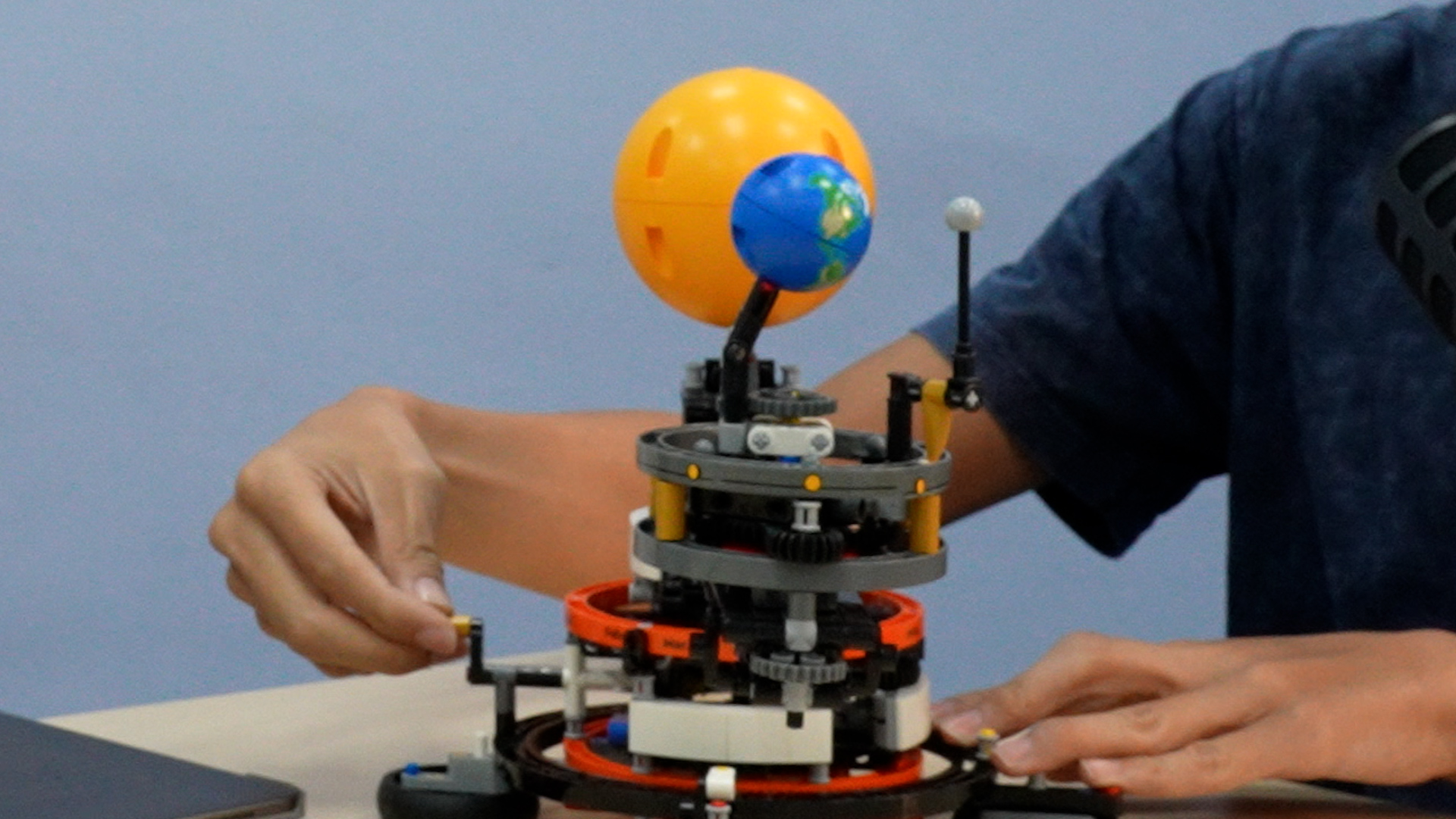
Okay, so I have some embarrassing questions. Just for context, everyone at home I am not science trained. I'm from the media team. So my embarrassing question is: Are all lunar eclipses red?
Meng: What we're going to see on 3rd March, is what we call a total lunar eclipse, because the whole moon enters the shadow of the Earth, right? That's a total lunar eclipse. But there are some lunar eclipses where the moon doesn't fully enter the shadow of the Earth. So it looks like it's going to become smaller and smaller and smaller. And then at some point, it will start getting bigger and bigger again, so you will never enter that red colour phase. This model doesn't show you the tilt of the moon. But it would be like slightly a little bit higher or a bit lower. And that's why it doesn't fully go through the shadow of the Earth. And that's called a partial lunar eclipse. There's also a partial solar eclipse where it happens in the same way. So only a bit of the sun gets covered.
Lydia: Okay. But what is a difference between, for example, a blood moon and a lunar eclipse? Blood moon is also red, right?
Meng: They are actually the same. They are actually the same thing.
Lydia: So a blood moon is a lunar eclipse?
Meng: A blood moon would be more correctly known as the total lunar eclipse, where the moon enters the shadow and becomes red. But remember just now I said that there are lunar eclipses where it's a partial lunar eclipse. So the moon will be partially covered white and then black because again, exposure. But it will never become red because it doesn't fully enter the shadow of the earth. So, okay, you’re right to say that a blood moon is a total lunar eclipse. And then partial lunar eclipses, you won't get the blood moon.
Lydia: So this 3rd March is a blood moon?
Meng: It is a blood moon, yes. Correct.
Lydia: Okay, is there any fun fact about the moon that you want everyone to know?
Meng: Actually, not about the moon, but about eclipses. Okay, so eclipses always happen in a pair. Yes. So just now I mentioned, we have one on 3rd March. There's actually one happening next week, on the 17th of February, there's actually going to be a solar eclipse. But no one in Singapore can see it because this is happening in the South Pole.
Lydia: In the Antarctic?
Meng: In the Antarctic. Because of the tilt of the moon in relation to the Earth, it’s always in a pair. So when there is a solar eclipse, 15 days later there is going to be a lunar eclipse or vice versa. If there’s a lunar eclipse, then 15 days later there’s a solar eclipse because of this pairing that they have. So we’re actually going to have a solar eclipse on the 17th of February, and that coincides with the first day of Chinese New Year.
Lydia: Cool. Do you think there's like, some cultural significance to this, I mean, for it to coincide with the Chinese New Year.
Meng: Oh, that's because of our calendar system.
Lydia: Okay. And this, you're going to talk more about during the livestream, right?
Meng: I am going to talk more about that during the livestream. It's a long topic.
Lydia: So if anyone's is interested in the livestream, you can either catch it on our Science Centre YouTube channel or you can come down to the centre starting from... what time? 6:00 p.m. where there'll be some activities, and then there'll be a live streaming feed as well. And of course, you can look up to the sky and see the lunar eclipse.