

How to Train Your Robot
Episode 2: How to Train Your Robot
Have you ever seen humanoid robots walking the streets or going viral online? How do they move? Why don't they fall while carrying out all those fancy moves? In this episode of Void Deck by Science Centre Singapore, Lydia sits down with in-house 'robot trainer' Wenjun to unravel how such humanoid robots work.
Listen to the Full Episode
Available on: Spotify, Apple Podcasts , and Amazon Music.
Subscribe to Void Deck wherever you get your podcasts to get notified when the next episode drops.
Episode Highlights & Timestamps
-
01:11 Introducing the Unitree G1 Humanoid Robot
-
02:00 How can the robot do boxing?
-
03:10 How does the robot learn?
-
04:23 What can it help us with our daily lives?
-
05:00 'Would You Rather...' 05:43 Can robots replace humans?
Guest biography
Ms. Wenjun Liang is a Senior Science Educator at Science Centre Singapore. On a daily basis, Wenjun can be found around the centre conducting shows and interacting with guests. For the RoboFest, Wenjun has been specially trained to work with robots.
Transcript
How To Train Your Robot
Lydia: What are some of the actions that you have taught it?
Wenjun: Like, for example, if we want it to point directions to the left or to the right, it does have those corresponding actions as well.
Lydia: Actually. Can we do a ‘cheers’ with it right now with our drinks?
Wenjun: Oh, sure. Of course! It knows how to cheers.
Lydia: Oh, okay! You taught it already? Has it been drinking?
Wenjun: Uhm... (crickets).
Lydia, Wenjun and the Unitree G1 Humanoid Robot cheers with their Oatside drinks.
Lydia: Oh, not bad. This is my first time drinking (Oatside). Actually, you can find the Oatside drinks at the RoboFestival.
Introduction
Lydia: Hello and welcome to Void Deck by Science Centre Singapore. I'm Lydia and today we'll be talking about robots. Today we have a special guest with us. This is the Unitree G1 humanoid robot. And of course, we have Wenjun from the Gallery Experience team from the centre. And she's been working very closely with these robots for the upcoming robot festival.
If you want to know more about the festival, do tune in to the end for more details. But first! Wenjun, can you tell me more about the robot?
Wenjun: Okay, so over here is the humanoid robot. In other words, it's also a bipedal robot. Meaning, they are designed to walk, climb, or actually run on two legs just like humans.
This robot will be joining us for RoboFest. It will be co-presenting,
as well as joining us for the actual launch event.
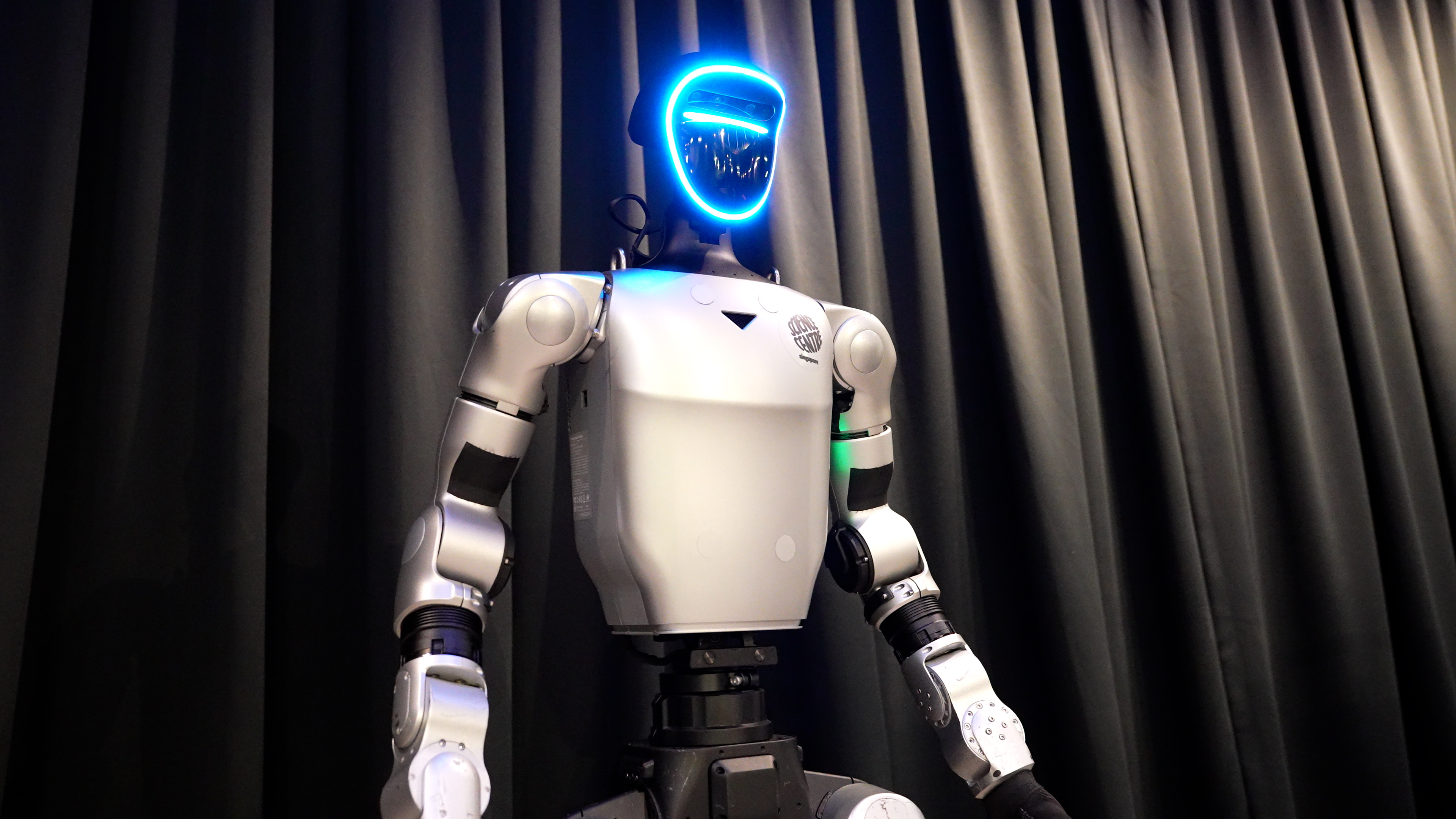
For our listeners without any visual reference, we are currently featuring a life-sized robot standing at about 130cm. It has a face, arms, legs, all made of mainly lightweight, high-strength materials. You can check it out in our show notes in the link below, or head over to our YouTube channel.
Lydia: Wow, is there anything else it can do?
Wenjun:It can dance as well. It can do simple moves. And of course, it’s also able to do boxing. So you will be able to see them at our RoboFest too.
Lydia: Wow! Wait, how can it box? Can it sense when someone is about to punch?
Wenjun: Okay, so this robot is fixed with sensors. So there's actually a 3D lidar sensor that's able to help it to detect obstacles around, to give it spatial awareness, as well as the camera that's also inbuilt that is able to -- it's actually kind of like a depth camera.
Lydia: So this is the camera right here? (points to the robot’s face) There's a lot of cameras! One, two, three, four cameras.
So this can withstand boxing? If someone boxed it, will it break? (pokes the robot) Oh, it’s actually very sturdy and very hard.
Wenjun: Yes. It's made of sturdy materials. And also, its sense of balancing is really good. Just like us humans, right? When we feel like we are going to fall forward or we're going to fall backwards, we are able to adjust ourselves. So similarly for the robot, it can also adjust to try to maintain its balance as much as possible.
Lydia: Actually, it feels very steady. How much does this weigh?
Wenjun: This model that you see here is approximately 35kg.
Lydia: So all these actions that it can do, how does it learn to do them?
Wenjun: So some of the actions are already inbuilt. But for some of the newer actions, or very specific actions that we need it to perform, we can actually give it some training.
Okay, maybe I need the hand to move a certain way? Or within a certain time: seconds, duration? We can give it that training as well, then it can remember the exact movements and is able to perform those movements again.
Lydia: So has there been any interesting moments when you were training the robot?
Wenjun: It's never so easy at the start when we are trying to learn how to train it. So for example, how the joints actually move, how the weight or the center of gravity for the robot actually shifts when we are giving it new moves. So sometimes we realize that, when it’s trying to re-perform the move, it starts to go a bit off balance. So that's when the self-balancing functions for this robot comes in. Very important. It will stumble a bit maybe, then it will start to balance back by itself.
Lydia: I see. So there are some restrictions as to how much it can move. And you have to make sure it's within a certain parameter.
Wenjun: Yeah. For the upper body especially.
Lydia: So what can it do for us on a day to day basis. Can it help us with our daily lives? Can it go shopping with us? I don't know. Can it help us with our house chores?
Wenjun: Actually, this robot, I will say, even though it looks like a human, there are still quite some limitations. For example, if you are wiping the windows using a damp or wet cloth? Then we might need to make sure that it doesn't interfere with the mechanisms or with the electrical parts of the robot itself. Unlike us humans, we’re okay and perfectly fine with coming in contact with wet cloth, with washing clothes. But not all robots can do that.
Would You Rather…
Lydia: Would you rather have one very advanced robot or many simple robots?
Wenjun: Actually, I want both. Is there an option?
Lydia: Would you rather a robot look more robotic or look more like a human?
Wenjun: Robotic.
Lydia: Why?
Wenjun: If it looks really, really like a human, then will it come to the extent whereby people are, (like maybe for me), will I be second-guessing what I'm seeing? Is it really a human or a robot? But I would say if a robot really looks like a human, it does give that visual impact, that wow factor, that ‘wow that's how much robotics have advanced over the years.’
Lydia: Do you actually think that this robot can replace humans?
Wenjun: Not at the moment. While I will say robots are more involved in our daily lives and we are embracing robots more and more like even our home -- the washing machine is actually considered a robot. But I will say in terms of replacing humans, it will be a no. Because although AI is on the rise, I think there's still a difference between a human brain and an AI brain.
Lydia: Cause for this one anyway, you program it right? You need a human to program this. Okay, so for the upcoming robot festival, do you have any more information about that?
Wenjun: It's going to be exciting.
Lydia: So other than this, will there be other robots as well? Other types of robots?
Wenjun: Yes. We also have a robot dog that will make its appearance for one of our shows as well. Maybe you will encounter some robots that are able to serve you something.
Lydia: Serve us something? Serve us food?
Wenjun: Edible stuff.
Lydia: Wow! Okay. I think I'm quite excited for this.
So our robot festival is happening from 9 to 12 April during our normal operating hours. So do come down and join us if you're interested in looking at our robots and interacting with them.
For more information on RoboFest, click here.