
Episode 3: Deep Dive Into... Deep Dives
We ask our science educators (who dive) about all things ocean.
Episode 3: Deep dive into deep dives
What's the difference between scuba and free diving? What kind of marine life is in Singapore? What sounds do you hear underwater? Can corals get un-bleached?
And most importantly, what on earth is zooxanthellae?
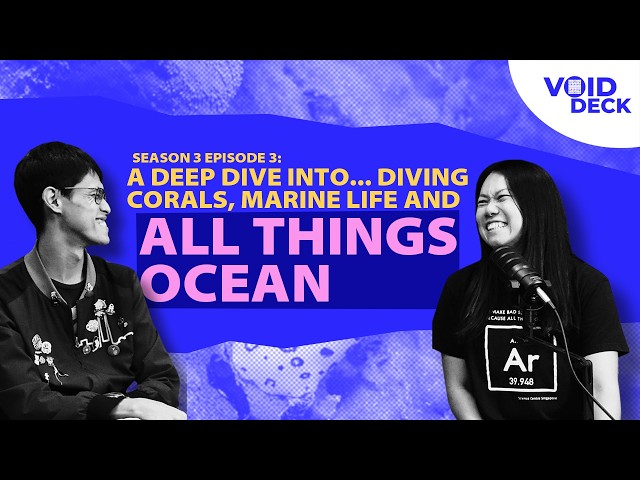
In this episode of Void Deck by Science Centre Singapore, Lydia asks science educators Meng and Edna to deep dive into all things ocean.
Listen to the Full Episode
Available on Spotify (opens in new tab), Apple Podcasts (opens in new tab) and Amazon Music (opens in new tab).
Subscribe to Void Deck wherever you get your podcasts to get notified when the next episode drops.
Other Resources
For more ocean content, join us for our Science Cafe panel discussion on 26 June 2026: https://www.science.edu.sg/workshops-activities/science-cafe (opens in new tab)
OR get your tickets to ONE Ocean here: https://www.science.edu.sg/whats-on/one-ocean (opens in new tab)
Episode Highlights & Timestamps
00:00 - 01:23 Introduction
01:23 - 03:11 Scuba and Free Diving
03:11 - 04:25 Marine Life: Dugongs
04:25 - 05:16 Marine Life: Peacock Mantis Shrimps
05:16 - 05:52 Marine Life: The Number 1 Rule
05:52 - 08:41 Marine Life in Singapore
08:41 - 11:46 Difference between Scuba and Free Diving
11:46 - 13:38 Are corals plants or animals?
13:38 - 15:48 Sounds underwater
15:48 - 16:28 Are whalesharks whales or sharks?
16:28 - 17:16 What is a plankton?
17:16 - 18:38 Coral bleaching
18:38 - 20:03 Guest Feature: Tara Ocean Foundation
Guest biography
Mr. Lim Meng Hwee (Meng) is a Senior Science Educator at Science Centre Singapore. Some of the classes he teaches include the Aquatic Plants & Animals class, as well as astronomy workshops and planetarium live shows at the Omnitheatre on some Friday nights.
Ms. Edna Chan is a Master Science Educator from the Gallery Experience & Sustainability team at Science Centre Singapore. She hosts some of the flagship shows at our centre, such as the Energy Titans and Fire Tornado shows.
Transcript
Lydia: Whaleshark is a whale or shark?
Edna: It’s a whale...
Meng: Nooooo. A whale shark is a shark!
Edna: Really!? It’s a shark!?
Lydia: That’s why the ‘shark’ is at the end.
Edna: Ok -- let’s cut this part off.
[Blooper screen]
Introduction
Lydia: Welcome to Void Deck by Science Centre Singapore. I'm Lydia, and today we'll be talking about the ocean. From marine life to diving to sounds of the ocean. Some might even say that there's a whole world beneath the surface.
Today we have Meng and Edna. Meng is a repeat guest and we have Edna as well. So both of them are Science Educators at the centre.
Meng: Hello again. So, contrary to my other appearance here, I'm actually a biologist by training.
Edna: And I'm Edna. I majored in chemistry but I also have a diploma in veterinary science. And I'm a leisure free diver.
Meng: And I’m a leisure scuba diver.
Lydia: This vodcast is extra special because we are recording right in front of our upcoming ONE Ocean exhibition. So for all of our listeners, there might be some extra sounds going around. We're just going to embrace them.
And of course, for our listeners on YouTube and Spotify, you have more visual reference. So if you want to know more about our upcoming exhibition, do stay tuned to the end.
More about how Meng and Edna started diving
Lydia: Today we picked both of you to be our guests because both of you dive at your own time, right? Can you tell us more about that? How did you start?
Meng: I'm a scuba diver, so scuba basically means we are underwater for a lot longer. We bring our own air down. I started it because of my love for animals. So I wanted to go underwater and see them. So I had a few friends who were interested and then we all went to learn together. And then here I am, nine years, ten years into the hobby, plus going to 200 dives.
Edna: For me, I do free diving. Basically I free dive without any, you know, heavy gear. Like I don't have an oxygen tank with me. What I use is really purely on breath hold, so my own breath. So I love it because I feel very free. Exactly.
But, apart from that, it's also the ocean and the marine animals, just like Meng, that brought the love of diving.
Lydia: Wait, so how long can you hold your breath?
Edna: We have, like, two types of breath hold. In a way, we call it ‘static’, where we train our breath hold. So, I'm not very professional. My static is about two minutes, but when I'm active swimming in the ocean, I can go up to one minute.
Meng: Which is interesting because in scuba diving, we were taught not to hold our breaths.
Edna: Exactly.
Lydia: Oh yeah, because you have the oxygen tank with you.
Meng: So just to correct- It's not an oxygen tank, so it's just a tank of compressed air with the normal composition of air around, so it's just compressed. We cannot- you cannot breathe pure oxygen under water. It's actually toxic.
Some of the animals they've seen on their diving trips
Lydia: So where have you dived before? Have you seen anything interesting?
Edna: There are really beautiful things that you can see. Every place you can see different things. I've also been to the Philippines. So, you know, you can see whales, stingrays, dugongs. That's one of my favorites, seeing dugong.
Lydia: Okay. I have a dumb question. What is a dugong?
Edna: Um... What's a dugong? Okay, actually, dugong is kind of endangered, so it's a conserved animal. So actually, for me to even dive with the dugong, it has strict regulations, like you can dive with it for, like, 15 minutes. And it was like a two hours drive there and a two hours wait on the boat before I could dive with them for that 15 minutes. If you’ve heard of sea manatees...?
Lydia: Okay.
Edna: Yes. It's a similar species, but they are slightly different.
Lydia: Okay, but it was all worth it, right?
Edna: The 15 minutes? Definitely worth it. I wish I could stay longer and just, you know, even admiring them from far and observing their behaviour is something that I think is what we divers love to go back and dive every time.
But one significant moment I had was when I was diving down, the dugong gave out a sound. At first I thought it was my mask leaking. Like, eh, that’s weird, is my mask leaking? There was a ‘krrrk’ sound but after that, when I looked back at my video, it was actually the dugong giving out a sound. It was so cute. It's like (mimics dugong sound). It really sounded like air was leaking out from somewhere.
Meng: For me… I like the big stuff, but I particularly like a lot of the smaller animals in the water. So, in my recent trip, I think, was it to Komodo? We saw a lot of peacock mantis shrimp. So those are my absolute favorite animals underwater.
And we saw a lot of them out in the open so I could see the whole entire green body and the face and all. So, they’re supposed to be a bit skittish but it seems like the ones in Komodo were very, very daring so, they just stayed there. So it just makes a very good photography target so just go there and shoot (your camera).
Lydia: They’re very friendly?
Meng: No no no no no. These guys can punch my camera. So they’re the ones with the supersonic punch kind of thing. Very dangerous. They can punch aquarium tanks.
Lydia: And it can break your camera?
Meng: They can break my camera if they want to. So it's dangerous. So you want to go close but then you don't want to go too close.
Lydia: So when you're diving, you get up close and personal with all the marine life. Is there anything that you have to keep in mind?
Meng: No touching!
Edna: Exactly. And always maintain a distance at least of, like, one meter or so, depending on the size of the creature. So, for example, dugong, we usually keep, more than one meter away. Yes, so we try to maintain at least 3 to 5m away from them.
Meng: Yeah. Basically don't reach out. Don't disturb them. Don't try to maneuver them to do anything. Let them be. They will do what they do.
Edna: Yeah, just remember we are the visitors in their area.
Meng: Correct, right.
Marine biodiversity that can be found around Singapore
Lydia: Now let's talk about marine life around Singapore. Do you know any nice marine life around Singapore?
Meng: Shaun the Sheep!
Lydia: What is Shaun the Sheep? Is it a sheep?
Meng: No. Shaun the Sheep is amazing, alright? Shaun the Sheep is a nudibranch.
Lydia: Sorry, what is nudibranch?
Meng: Nudibranch is basically similar to sea slugs. They're from the same family of sea slugs. But it's a group of animals on their own. So whenever you see pretty, like, sluggish looking animals underwater or photos of that blue, green, red, you know, and they are very pretty. Those are usually nudibranchs.
Lydia: I always associate slugs with, sorry, ugly creatures.
Meng: But not underwater. They're vibrant. And they are tiny. Like tiny, tiny. Maybe the size of a very big, full stop on your paper. Yeah, that small.
Lydia: Then how do you see it?
Meng: So when divers go find it- this is in Pulau Hantu- So there’s Shaun the Sheep in Pulau Hantu, in the waters. And people have to find the sea grass or the seaweed or the food source. And then you look on the leaf to try and find Shaun the Sheep.
Edna: Do you carry a magnifying glass?
Meng: Some of them actually do, yes. Some of them actually do. They are tiny, but they are beautiful. So if you ever Google Shaun the sheep, it looks like a sheep underwater. It has little green leaflets on its body that also help with photosynthesis because when they eat the food plant, they also absorb the chlorophyll from the plants into their own body.
Edna: But I know in Singapore waters there's a lot of nudibranch species around as well. As well as really beautiful corals around. It's just that our water is a little bit unclear, but because of the unclear waters right, there is less tourism in the waters which leads to such beautiful sea creatures.
Lydia: Wait, why is it so unclear?
Meng: Shipping lanes. So Singapore is a very heavy shipping lane, wherever it is around us.
Lydia: Because we are a port, right?
Edna: As well as land reclamation.
Meng: Correct. Yeah. But honestly, just now I was mentioning, Pulau Hantu is a great diving site. Visibility is quite bad in the sense that at this distance, I can't see Edna.
Edna: Yes.
Meng: But because of that, it's like a jewel box where it's like a treasure chest where you go down and just find things and you’ll find-
Lydia: Because it's been so untouched by humans, right?
Meng: Yeah, pretty much so there's many, many nudibranchs down there.
Edna: There are so many different species. Some look like really cute bunnies in water.
Meng: Got their little ‘ears’.
Edna: Yes.
Meng: And there’s Shaun the Sheep.
Edna: And some have- I've seen one which is like full black with really neon, bright neon blue around it. Yeah, it's really beautiful and glowing in the water.
Differences between scuba and free diving
Lydia: Okay, Meng does scuba diving and Edna does free diving. Can you tell me what the big differences are? Do you guys use the same flippers or mask or anything?
Meng: I thought our mask was the same, but no, apparently not. So I know the fins are different, but I didn't know the mask was also different. So today I learned, right?
So this is my fin. 30-40cm?
Lydia: Almost the length of your forearm, right?
Meng: Yes. About the length of my hand plus my forearm. Yes. Correct. Okay. It's heavy. And, for me it's a little bit special because for me, I use what we call ‘split fins’. It just gives me more kick.
But, there are people who use shorter, heavier fins and there are people who use a little bit longer. But, you know, one solid piece compared to Edna’s flippers.
Edna: Yes. Mine is at least 90cm.
Lydia: That's longer than your arm!
Edna: Yes, that's really long.
And the difference with Meng’s flippers is mine is really light. So it's made of carbon fiber. So for free divers, we want the fins to be as light as possible because, in a way, we want to use as little energy as possible while diving so that, when we hold our breath, we don't consume too much oxygen in our body.
Lydia: And how about your mask? What's different?
Meng: Oh, comparatively, Edna’s mask has a lot less air pockets.
Edna: Yeah, maybe we should put it side by side.
Meng: So her mask is more slim, and hugs her face more. My mask is just ‘out there’.
Lydia: Out there??
Edna: It's more protruding, it contains more air. Yeah. So what happens? Because for free divers, we want the mask to be small. As we dive down, the deeper we go, the pressure is higher. So when we are in the depth, oxygen, or rather air, gets compressed, so it's a lesser volume. So when we are wearing this mask, it gets less volume. The pressure here is very high. It's so high
Lydia: Pressure on your face?
Edna: On my face, even the ears. So there's this thing what we call equalization that we have to do constantly. So with lesser air volume in a mask itself, it's easier for us to equalize as compared to a mask with a bigger volume.
Meng: As you go down, your ears start to hurt because of the pressure of the water pushing in, so we always have to just blow air in, equalise the ears. If not, it's impossible to go down.
Edna: Yes, it will be very painful and uncomfortable as well. And it's also very dangerous because this can cause some hearing loss as well if you do not do it correctly.
Meng: Yep, yep.
Lydia: Yours has an additional item.
Edna: Yes, a snorkel. That's because for free divers, remember we use our breath only. So most of the time, we are also on the surface. So this helps us to breathe on the surface itself before we advance into the depth.
Meng: So there's something that I have that she doesn't have. So this is called a BCD, Buoyancy Control Device (BCD). Basically it's a big bladder of air to compensate for some of the weight that I'm wearing down. To keep me afloat.
Lydia: So it’s like a vest that you put on. So you put it on like a backpack.
Meng: Correct. And then the good thing is when you're above water, you can inflate this. And this becomes a little buoy above water. So you float on the surface. Most importantly for me, it’s to float on the surface. If not, with all the weights I carry, it's a risk that I will sink down.
Pop quiz on marine life
Lydia: We have looked at the differences between free diving and scuba diving, but the one big similarity that you guys dive for is marine life. Okay, so let me test you on your marine knowledge right now. So whoever knows the answer, just say it as fast as you can.
My first question is, are corals plants or animals?
Meng: Okay, corals are animals. They belong in the same group as jellyfishes and sea anemones. So they belong in the same group of animals as those. Imagine a sea jelly, but upside down.
But within a coral body, what we call the ‘coral polyps’ there are what we call ‘zooxanthellae’.
So those are plankton or some sort of algae. So it's protists that help with photosynthesis. So corals- the coral polyp can photosynthesize, but at night they will actively feed. So they will eat whatever free floating stuff is around and just gobble it down with a little mouth in the middle. So they are technically animals, but they have some plant-like properties because of the algae that they store within them.
There are many different kinds of corals and at night they look very different from their daytime because at night they come out a lot more to do feeding. The whole entire line of coral- what we call the Cnidaria, are so primitive that you cannot compare them to the animals that we have that we normally see. They do have a mouth, but they have like one mouth and probably that's the same mouth part that things come out of and they have some arms. They are very, very simple creatures.
Edna: I learned something also from the biologist.
Lydia: Now we are going to see whether you know some sounds. Do you actively listen to the ocean when you are scuba diving?
Edna & Meng: Yes...
Meng: But for me… because- hmm, how to put it? You will hear a lot of your own breathing. So it's breathe in, breathe out (underwater breathing sound)
Edna: From the regulator.
Meng: Yeah, the regulator.
Lydia: So maybe you hear more things because you’re not breathing.
Edna: I do, I do. But also our focus is mainly to try and spot things. Also, free divers, we take a lot of photos or rather, I do. So, we take a lot of photos and when we are ready to go down, right, we usually swim or rather dance in the water more.
Meng: Dance? As in..?
Edna: Yes, dance! Freedom! Because we don't have all this gear. So we are very free from all the gear, right? So it's literally like dancing in water. You turn, you flip, you back roll, front roll. You pose for as long as you can. And you know, the photographer will be taking, snapping away and videoing you.
Lydia: Okay, so let's listen to some sounds. We will start with an easy one.
(Dolphin sounds)
Edna & Meng: Dolphin?
Lydia: Yes, that was super easy. Okay, since it's super easy, we will go with the harder one.
Edna: Wow.
Lydia: Maybe Meng will know this. I don't know.
(Snapping Shrimps sounds)
Meng: You know what it sounds like? Like deep frying food!
Edna: Yeah, it's making me hungry, you know?
Meng: But if I were to guess. Sounds like shrimps.
Lydia: Yes!!
Meng: Snapping shrimps.
Lydia: That's right.
Edna: Honestly, can you really hear the shrimp snapping while you're diving?
Meng: When you’re near the corals, you can. You can hear. Yeah.
Lydia: So you hear the (mimics snapping shrimps sounds)
Meng: Yeah, you hear a bit. But it's usually at night. At night you will hear them because they are more active at night. So there's a whole section of night diving. Yeah, you have to bring your torchlight down.
Lydia: We'll just do one more. It’s super easy.
(Whale sounds)
Edna: Whale?
Meng: Whale.
Lydia: Yes! It's a whale.
Meng: I've never seen a whale.
Lydia: Have you?
Edna: I've seen… What’s that whale… Whale shark.
Lydia: Whale shark is whale or shark?
Edna: It’s a whale.
Meng: Noooo.
Edna: Really?
Meng: Whale shark is a shark.
Edna: It’s a shark?!
Meng: So, Edna, do you know how to tell the difference? Between a whale or shark?
Meng: You look at the-
Edna: The fin?
Meng: You look at the tail. So shark tails are vertical. So they flip left and right. Then for whales, dolphins, dugongs, manatees, the mammals, they will go up and down.
Lydia: So now let's go even deeper to the smaller creatures in our ocean. What is a plankton?
Meng: A plankton is a cover name for a very big group of animals who are microscopic. Sometimes not microscopic… Sometimes they're quite big. By big, I mean maybe, size of your fingernail or smaller, but they are usually free floating in the water, and they form pretty much the base of the entire food chain in the ocean.
And so there's, like, millions of plankton. Yeah. Different kinds. It can be baby crabs that are plankton, baby lobsters. It could be coral polyps, free floating corals that are still young. It could be worms. It could be anything, that's free floating in the ocean.
The science behind ocean acidification
Lydia: Okay, so we’ve talked about biology. Is there anything chemistry wise that you think is worth mentioning?
Edna: Maybe one thing to take note, if the acidity of the ocean is high, you know, there's a chance where once, you saw really beautiful corals there, it might not be there any more throughout the year.
Meng: Ocean acidification.
Lydia: As in the coral will get bleached, right?
Edna & Meng: Yes
Lydia: Can it be unbleached?
Edna: Yes. It takes time also for the right acidity level of the ocean to go back to its usual state for the coral to survive.
Lydia: And when we say the corals get bleached, it means they are dead, right?
Meng: Not exactly. So remember, just now I was saying the corals have the algae in them? The zooxanthellae? So when the corals are stressed, they will sometimes eject the zooxanthellae out. So that's what gives the coral colors. So when you eject them out, the corals become white. It's when we call bleached corals. So it takes time for them to reacquire the zooxanthellae, and that's when they get their color back. So when the coral is bleached, it can't photosynthesize because it doesn't have the zooxanthellae. But it can still eat, but it's significantly diminished in terms of survival. So it's basically starving. So if it goes on for too long then yeah, the coral would die.
Lydia: So our upcoming ONE Ocean exhibition focuses on conservation. And, there's a research group, the Tara Foundation that goes to the Arctic, drifts with the ice. Do you guys actually have any questions for them?
Meng: How fast has the Arctic been warming? Compared to the rest? Because they will face a lot more challenges than the rest of the world in terms of facing this global warming threat.
Quick interview with Mathieu from Tara Ocean Foundation
Mathieu: Hello. I'm Mathieu, I'm working at Tara Ocean Foundation and I worked on ONE Ocean: Every Action Ripples since six months ago and throughout to make it possible.
Lydia: Someone asked us, how much more is the Arctic warming compared to the rest of the world? And how would that affect the rest of the world?
Mathieu: So, it's approximately four times faster than the rest of the world, and we don't really know how it will affect the rest of the world. But we do know that there will be changes in the currents either in the atmosphere or either in the ocean. And this change, because of the melting of the sea ice, could affect our global climate, either in temperate zone or in tropical zone. Transformation can change the speed of some currents. And this will have ripples everywhere.
Conclusion
Lydia: And that's just a small glimpse at what you're going to see in the ocean. So if you want to know more, do check out our upcoming exhibition ONE Ocean, opening 30 May at Science Centre Singapore. You can get your tickets online or in the description below.
And if you're curious to go deeper, do join us for our Science Cafe session in June, where we'll be bringing in some speakers from the Tara Foundation and Ocean X, where you can learn more about the ocean and what these experts do in these industries.
Edna: I'll be going. Will you?
Meng: I will be going.
Lydia: The three of us will definitely be going.
So step into ONE Ocean. Every Action Ripples.