
Episode 4: The Moon, Its Cultural Significance, and Its Belly..?
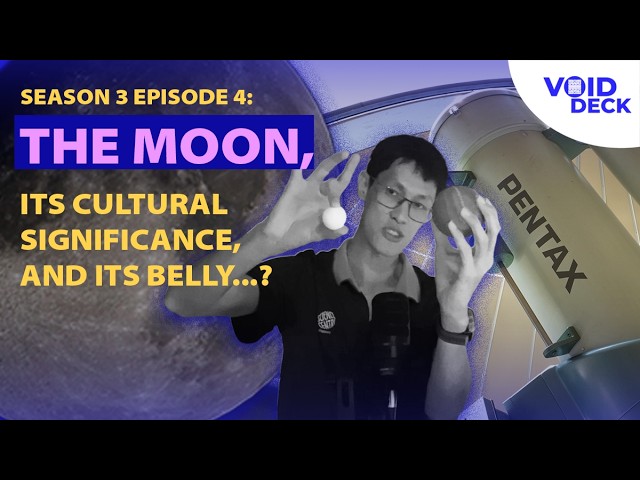
We explore the Moon's significance in many cultures, why we only ever see one side of the moon, and talk about a recent man-made crater.
In this episode of Void Deck by Science Centre Singapore, Lydia asks science educator Meng all about the Moon.
Listen to the Full Episode
Available on Spotify ↗(opens in new tab) (opens in new tab), Apple Podcasts ↗(opens in new tab) (opens in new tab) and Amazon Music ↗(opens in new tab) (opens in new tab).
Subscribe to Void Deck wherever you get your podcasts to get notified when the next episode drops.
Other Resources
For more Moon content, join us for Celestial Nights on 25 & 26 September 2026. More info here: https://www.science.edu.sg/whats-on/celestial-nights (opens in new tab)
Episode highlights and timestamps
00:43 - 01:12 Introduction
01:12 - 02:10 The moon and its relevance/significance to various cultures
02:10 - 02:40 Why we only see one side of the moon: the science behind tidal locking
02:40 - 03:37 How tidal locking affects the shape and movement of the moon
03:37 - 04:16 What’s unique about our moon
04:16 - 06:39 Lunar impact of SpaceX rocket’s upper stage
06:39 - 07:19 Conclusion
Transcript
Lydia: How long does it take for our moon to orbit Earth?
Meng: What do you think?
Lydia: There's the lunar cycle, right? And according to the lunar cycle it’s around like, 28 to 29 days.
Meng: Correct. And what do we call that? A period of about 28 to 29 days?
Lydia: Menstrual cycle.
(Both start laughing)
(Bleep sound)
Meng: It's a month!
Lydia: That’s the word that you were looking for. Okay can.
Meng: And the word “month” is derived from the word “moon”.
Lydia: Oh is it?
Meng: It is.
Introduction
Lydia: Hello and welcome to Void Deck by Science Centre Singapore. I'm Lydia, and today we'll be talking about the moon. Today, we have Meng again.
Meng: Hello.
Lydia: Thank you for joining us.
Meng: No problem.
Lydia: And we’re also actually preparing for our upcoming exciting festival. Do you know what festival that is?
Meng: So that is the Celestial Night for Mid-Autumn that is in September.
Lydia: Yes, that's right, it’s the Celestial Nights commemorating the Mid-Autumn Festival. But actually, how is the moon related to the Mid-Autumn Festival?
The moon and its relevance/significance to various cultures
Meng: So Mid-Autumn is supposed to be, or at least the Chinese say, is the eighth month, 15th day, which is the Mid-Autumn Festival. So that is the eighth month of the lunar calendar, the 15th day.
That would be when the moon is full. And then we can sit back, eat some mooncakes, drink some tea and look at the sky. Look at the moon.
Lydia: Sounds nice. Are there actually other cultures that use the moon for a certain significance?
Meng: Of course. Of course. The first day of Chinese New Year would be a new moon. And then the last day of Chinese New Year, it will be a full moon.
That is the same for the Islamic calendar as well. So Ramadan falls on the first sighting of the crescent moon, which is near the first day of the new moon. And that goes for one full month until the sighting of the next new moon.
(For) our Indian friends, I think Deepavali also falls on a new moon, if I'm not mistaken.
Yes, a new moon as well.
And then, probably somewhere, we have already mentioned. But Easter and Good Friday also kind of follow the moon.
Why we only see one side of the moon: the science behind tidal locking
Lydia: Why do we only see one side of the moon?
Meng: It's due to this effect called tidal locking. How I like to describe it is you take out your phone, you take a selfie, right?
Lydia: Uh huh.
Meng: Yeah. Your screen is always facing you. As you turn, the screen always faces you as well.
So that's the same, that's the same face of the moon that always faces you.So (opens in new tab) that is why we only see one side of the moon.
Tidal locking is basically the same thing. So the moon goes around the Earth, but only one side ever looks at the Earth at any one time. It makes one round on its axis at the same time it makes one round around Earth.
How tidal locking affects the shape and movement of the moon
Meng: And this is because of the tidal locking. So basically when the moon was forming.
So this has to go back to nearing the formation of the moon. And even the moon now it's not a round ball like this, right?
Even the moon now is slightly bulged nearer to us. There's a little belly. Basically, it’s got a belly.
So that belly is facing Earth, right? And because of that belly, the pull of Earth's gravity gently tugs it such that the belly always faces Earth.
So as the belly faces away, it pulls it back. So every time the moon spins, it pulls it back slowly, pulls it back slowly, pulls it back slowly until that bulge faces Earth.
And it's not just our moon. Pretty much all the large moons in our solar system are all tidally locked to their planets. Because of the same gravitational pull of the parent planet.
So we are not, we're not special in this front. Every other large moon in the solar system also has that effect.
What’s unique about our moon
Lydia: Is there anything actually special about our moon?
Meng: We are in a period of the planetary system where we can see eclipses because the sun is 400 times larger than the moon, but it's also 400 times further away from us than the moon.
So in the sky they appear to be the same size. And when they appear to be the same size, and when they cross each other as an eclipse, the moon sometimes can perfectly cover the sun. And that's when we get a total solar eclipse.
The moon is slowly moving away, so we will lose that eventually. In about, I think they said a billion years, give or take a few million.
So… Better catch a solar eclipse while you still can.
(Bleep sound)
Lunar impact of SpaceX rocket’s upper stage
Lydia: Speaking of the moon, something happened recently.
Meng: Yes. Earlier this week, actually. I think you're talking about Space X.
Lydia: Today is 7th August. So, was it yesterday?
Meng: Yesterday or the day before, I think it was 3rd August.
So basically, Star X is tasked to start sending stuff to the moon to help with the Artemis missions, to start putting things in orbit around the moon, so that when the Artemis missions go there, they have something to dock to to form like a, pretty much a lunar ISS International Space Station, but around the moon.
So in one of these trips, the booster rocket that is sending the object there has done its job.
So it has launched the payload towards the moon and the… I'm not sure if the payload is orbiting the moon already, that one I can’t really be sure.
But the booster rocket itself is spent. Even though it's not, it's not boosting anymore, it still travels because of inertia. The object still travels.
So it itself went into orbit around the moon. But the orbit is not a stable orbit. So it doesn't keep going around. It slowly decays.
So it starts to fall towards the moon and into the moon, sorry. And then, a few days ago, it finally crashed onto the surface of the moon.
It was an expected crash. I mean, they didn't expect it to, have to orbit and and crash into the moon, but they would have calculated that, “Okay. It's going to crash.”
And where it's going to crash, what time.
Lydia: So they expected it to crash already, or? Was there a different expectation?
Meng: When it launched, no. But after calculations like, you know what, it's going to crash.
And because… There's a few things that are pretty cool here.
So they know how heavy it is, which is about 4000 kg. They know when it's going to crash. They know how fast it's going to crash because everything is calculated. They could predict the effect of it.
So how big your crater is going to be, how high the dust plumes are going to come out.
Lydia: And this will be a man-made crater?
Meng: This is a man-made crater, yes.
Lydia: But when It crashed into the moon, does it affect the moon in any way? Like will it, will the moon change direction or movement?
Meng: Theoretically, yes. Because whenever two objects interact with each other, there is momentum and forces that are being moved around.
So the moon will technically move that very little bit. But it is not, so much until it would change the course of the moon.
Lydia: Right… But that’s because the thing that crashed was...
Meng: It's not heavy enough. Yeah. It's not heavy enough.
Lydia: Okay, okay...
Conclusion
Lydia: Alright, so for all our listeners, if you are interested to learn more, you can check out our Void Deck website or YouTube channel.
And of course, you can come down to the Science Centre. Every Friday night, we have the observatory session.
And of course, in September… Do you have the dates?
Meng: 25th and 26th September.
Lydia: Those dates are when the Celestial Nights Mid-Autumn Festival is happening.
Okay, so that’s happening at Science Centre and I think a little bit at the Jurong Lake Garden.
Meng: Yes, on the Japanese garden side. So we will extend all the way to Japanese Garden.
Lydia: And we will have some activities...
Meng: We’ll have activities; I'm not going to say much, you have to come down to see for yourself, but definitely stargazing.
Lydia: It’ll be fun, it’ll be fun.
Meng: Yes.
Lydia: Alright, so see you next time.
Meng: See ya!