

Can We Outsmart Ageing?
As Singapore becomes a "super-aged" society this year, we explore the surprising science of ageing with theoretical physicist turned biotechnology entrepreneur Dr. Peter Fedichev.
Singapore stands at a demographic crossroads. According to previous projections, this year, more than 21% of our population will be 65 and above, officially making us a "super-aged" society—a milestone that brings both challenges and opportunities for how we think about growing older.
As Singaporeans invest in fitness gear and set New Year health resolutions, a deeper question emerges: how can we age well, and what if the very nature of ageing isn't what we think it is?
To explore the science of ageing, the Void Deck team spoke with Dr. Peter Fedichev, a theoretical physicist turned biotechnology entrepreneur who brings an unusual perspective to ageing research.
As co-founder and CEO of Gero, a Singapore-based longevity startup, Dr. Fedichev uses artificial intelligence and real-world data to develop therapeutics that could one day combat the ageing process itself. With over 20 years of experience spanning academic research and biotechnology, Dr. Fedichev is a pioneer in a new field called gerophysics that applies physics principles to the study of ageing.
Read on to discover Dr. Fedichev’s insights on why bats offer eye-opening lessons on ageing, how entropy drives cellular damage, and the opportunities for longevity research in Singapore.
The following interview was held in July 2025. It has been shortened and edited for clarity.
VD: How would you explain what ageing actually is? Is it just about getting older, or is there more to it?
DR. FEDICHEV: People are saying that we are getting wiser as we age. The truth is that our cognitive abilities decline after about the age of thirty. Almost any thirty-years-old chess player can defeat a six-years-old chess player, but there are no sixty-five-plus-years-old masters of chess, so no amount of wisdom can compensate for the decline in function.
For many people, ageing is a body shape variation. That's what people are concerned with a lot. But on top of that is loss of function–cognitive function. In sport medicine, there is another indicator, VO2 max, which can be measured by many even hand-held devices these days. This is essentially your ability to consume oxygen. This is like your power output.
Believe me, I mean, the data shows that—and you can also see it with your parents, grandparents, and everybody else—that it's hard to climb to the fifth floor if you're old. The ability to produce energy also declines more or less linearly with age. At some point, at about [a] hundred years old, this declines to a point that it's even hard to breathe, right.
So ageing is a loss of function, and that loss of function also implies that your body cannot protect you from diseases. People of advanced age suffer from infections which don't kill younger people—and COVID-19 was the [strongest] example—and people of age suffer from diseases.
So loss of function, which is ageing, leads to decline everywhere, age-related diseases, and sudden death from things that cannot kill a young man.
VD: So essentially you're saying that ageing is related to the resilience of one's body?
DR. FEDICHEV: Yeah, overall, I mean, there are many aspects to that, but it's really functional decline.
Look at people who are very old, ninety-years-old or hundred-years-old, surprisingly, these people are almost free of diseases. All their friends who had diseases are dead by that age. They are free from diseases, so technically they should be happy, but functionally they are ruined. I mean, if you look at anyone who is [a] hundred years old, these people functionally are in a terrible state, so this is ageing, unrelated to diseases, right, so there are like two components to that.
You can try to catch up with diseases as much as you want, and that's what the standard medicine is doing right away, right, if you have a diagnosis, they give you a pill or they give you a surgery, right, so that's how to keep people disease-free.
Unfortunately, in this way you don't intercept ageing, which is functional decline, so that's why I think it's very important to understand that ageing is not about diseases. Although, yes, lots of diseases come with ageing. If you focus too much on diseases, you'll end up in a situation where you don't have diseases, but you are a totally destroyed version of yourself.
VD: Speaking about ageing, nature seems to have some fascinating exceptions to ageing. We have the immortal jellyfish, Turritopsis dohrnii. We have the naked mole-rat. So could you tell us a bit more about animals that either age very slowly or don't seem to age at all?
DR. FEDICHEV: I think it's a very remarkable story because people knew that there are certain primitive creatures that do not age or can regress.
VD: Yeah, like the immortal jellyfish.
DR. FEDICHEV: Exactly, or there are these planarians. There are these worms that you can cut in many, many pieces, and each of them regenerates into a full worm. So basically, if these guys are bored and cannot find a mating partner, they simply attach themselves to a tree and cut themselves into pieces and they can still reproduce. Right, so if you are alone in the universe, this is not the end of the story. So these guys are technically immortal.
And by the way, I knew about that when I was a schoolboy. I was very interested in biology. I was interested in science overall, and I knew about those examples. But who are they and who am I, right? I am an apex of creation. I am, you know, the most advanced animal on Earth [laughs wryly]—I mean, that's at least my feeling was.
And I think this is an example of negligence, criminal negligence in science, because it turns out that there are mammals that age very slowly or presumably do not age.
People started suspecting about it in [the] late twentieth century, but I mean that's still very close. And then in 2006 there was a publication by Professor Buffenstein that those naked mole-rats, which are mammals, do not show signs of ageing. They don't show signs of functional decline. And of course, as always in science, they tell, maybe they show [signs of ageing], maybe in a long time.
But the issue is that in biology there is a very strong correlation. If you are small, you die quickly. If you are a fly or if you are a mouse, mice live like two years or something. And then if you are a whale, you'll live hundreds of years, right? So if you have a creature the size of a mouse and lives forty years, then I want to have this ability.
VD: Is there a specific animal that really piques your interest? Do you have one?
DR. FEDICHEV: I started with naked mole-rat, obviously, because that was proven. It's important in science to have proven examples, right, [because] we can speculate whatever. Also, think about this–assume that today you decided that yes, there are mammals that do not age.
Obviously, when people who were doing biology of ageing for the last 10,000 years, when they faced this presumably non-ageing animal, there was denial, like, "it ages, but very slow", "look, these guys don't control body temperature, they are probably almost hibernated, that's why they live longer."
And then, since you're asking me, what is the example which kind of negates all these arguments? These are bats.
So bats, one third of them [do] not age or age very slowly. So not most of them, but lots of them do not age slowly. And think about it. Most of the time people say that you don't age if you have low metabolism. But believe me, if you want to fly and be a mammal, you cannot have low metabolism.
So to me, this is an indication that longevity is not a compromise, because many people [are] afraid that, you know, you have to do [a] healthy lifestyle, boring life, preserve yourself at all times, sleep the whole day, wear [a] protective suit or something like that, and maybe you will live another ten years longer.
That's not the case in nature. You can be as metabolically active as a flying mammal and still not age. And to me, that tells you that there is a very good story there.

VD: You are a leader in a new field called gerophysics. But what exactly is gerophysics, and how does physics help us understand the biology of ageing?
DR. FEDICHEV: There was a gentleman in Great Britain in the early twentieth century who discovered the structure of atom, Professor Rutherford, who was the Nobel Prize winner. He said once that there are only two kinds of sciences, “there is physics and there is stamp collection.” So, anecdotally, he won his Nobel Prize in chemistry [laughs], but nevertheless, I think physics is at the forefront of science in many ways.
Physics uses lots of mathematics, lots of modelling, lots of computation. So historically physics was maybe the main science everywhere that was advancing our understanding of the universe. Physics has a culture of dealing with complex systems, and to nobody’s surprise, human bodies are sufficiently complex.
I think modern biology now has lots of tools to understand what happens on a molecular level in almost every cell. But that's precisely the situation where people stop seeing the forest behind the trees. So physics has a culture of generalising, of finding features that are a lot more important than others.
Because look, we have different races, we have different lifestyles, and still we live more or less the same lives. People in ancient Rome or Greece, if they survived till forty, they could well live up to eighty. You can live here. You can live in ancient Rome. You can have different diets and still, the life expectancy doesn't change five times. So that tells you that ageing is something about very universal features of biological systems. That's precisely what physics is studying. Physics is studying universal features of complex systems.
VD: So to sum it all up, gerophysics is really using physics, the concepts of physics to study ageing.
DR. FEDICHEV: Exactly. [Gerophysics aims] to study ageing across different animals, to study the most universal manifestations of ageing, because those things that are universal are more likely to be controlled.
[If] you want to develop drugs that work in mice [and] in humans, right, for trials, you want to end up with drugs that work in all humans. And for that you have to find mechanisms that are the most universal, and that's precisely what physics is doing.
VD: Your research shows that entropy may play a key role in ageing. Could you explain what entropy is and how does it affect our cells? Maybe using an everyday example?
DR. FEDICHEV: Yeah, well, first of all, it's very unfortunate that entropy drives ageing in humans. As we all know, if you have a kid’s room, or if you have your computer, in principle you can keep all your things in order. That's what people in hospitals are trying to do. But then, once in a while, a certain piece of a Lego set will disappear. No matter what. And then the whole piece, the whole set cannot be assembled anymore.
This is a very small thing, nothing life threatening. But then one of the systems, this Lego set cannot be assembled anymore. So we're built of, nobody even knows, how many molecules that work in a precise concert with each other to keep our body shape, for example. And of course, sometimes this complicated machinery just makes a very rare error.
Most of the time, this error can be fixed. But you know, we have too many things to do. Our bodies, evolutionarily, are trained to respond to stresses, to pathogens. So your body decides whether to fix that little thing, or maybe do an important thing. Maybe you're under attack. Maybe you are under attack by bacteria right now. So maybe that little piece doesn't matter so much compared to the immediate stress that you are getting. So as you are getting older, more and more, those little things are not fixed.
And the problem is that they are so much under the hood of your machinery that you have to stop the whole machine actually to find out which of them are broken. So essentially you have no time, no focus to fix them. And all those non-fixed things, they just build up, build up, and build up. The problem is where the entropy comes in, because entropy is disorder.
And the disorder here is that you have cell A and cell B. Each of them work the whole life, like two neural cells that work the whole life. And then cell A acquired this pattern of those small little things broken, and cell B acquired another bunch of little things broken. And these sets of broken things are not even the same. There are no two cells that have the same pattern of broken things, which means that you cannot come with a single intervention that will fix all the problems, because they're all different.
So the entropy here is this very complex pattern of failures. Each of them is benign, but together they build up in such a quantity that they produce stress, and that stress changes our body shape, destroys function. So we are just, you know, just leaning towards [the] earth under the pressure of those.
It's essentially damage. The damage that is so different in so many different cells that it's totally incomprehensible, and that's why it's very hard to control, and that's why it's very hard to revert.

VD: So speaking about ageing potentially being reversible–in your opinion, is biological ageing inevitable?
DR. FEDICHEV: That's a very good question, because I could tell you whatever I wanted, but since we have animals where the rate of ageing is either zero or very small, it's up to you to decide, right, from the limited evidence that we have. At least we have mammals that where ageing is very slow. To me, that tells you that it's not inevitable.
So what this physics is telling you is that ageing is very hard to revert. That's true, but you can still stop it.
VD: It’s not impossible.
DR. FEDICHEV: It’s not impossible to stop, right. In complex animals, the level of control that is required to reverse ageing is so large that you don't expect medical technologies within, let's say, next ten years to show up and actually being able to do that. In science and in technology, you never say never, right. I mean, "never" means "hard."
I think the practical conversation here is that because society is ageing so quickly we don't have lots of time to actually deal with that.
On a personal level, if I tell you that there would be a technology in fifty years that would solve the problem, it doesn't look very encouraging. So I think that--and this is our prediction, by the way--we believe that in ten years it's super realistic to build technologies that slow down ageing, if not completely, but like 10x, rather than demonstrate the technology that provides a meaningful age reversal, so no reversal theorem for ageing in ten years.
[The scientific debate on whether halting ageing or human rejuvenation is a better approach to healthy longevity is hotly contested. To explore the arguments from both sides, check out the 2024 livestreamed debate “How to Defeat Ageing” organised by Open Longevity, where Dr. Fedichev presents his perspective in more detail.]
VD: With Singapore being one of the fastest ageing nations in the world, how might understanding the science of ageing help us to prepare for this demographic shift? And what opportunities do you see for young Singaporeans who are interested in this field?
DR. FEDICHEV: Well, first of all, this is not only a problem of Singapore, but a problem of many other Asian countries, especially look at Japan right now. And since this is a global trend, it means that people who would be working on technologies to first stop, and then hopefully even revert ageing in the future, will be on the forefront of technological development.
In the National University of Singapore there is a world-class longevity centre led by world-famous scientists. I think for people who want to solve, really, a big practical problem, get famous, earn a lot, Singapore offers a possibility to train with the best people in the field with the support of the government understanding the issue. I think this is a very unique situation.
So for those who are interested in AI, biology, maybe physics and longevity and entrepreneurship around therapeutics against ageing, I think Singapore is probably [the] one singular interesting place in the world right now.
Explore The Science of Ageing at Science Centre Singapore
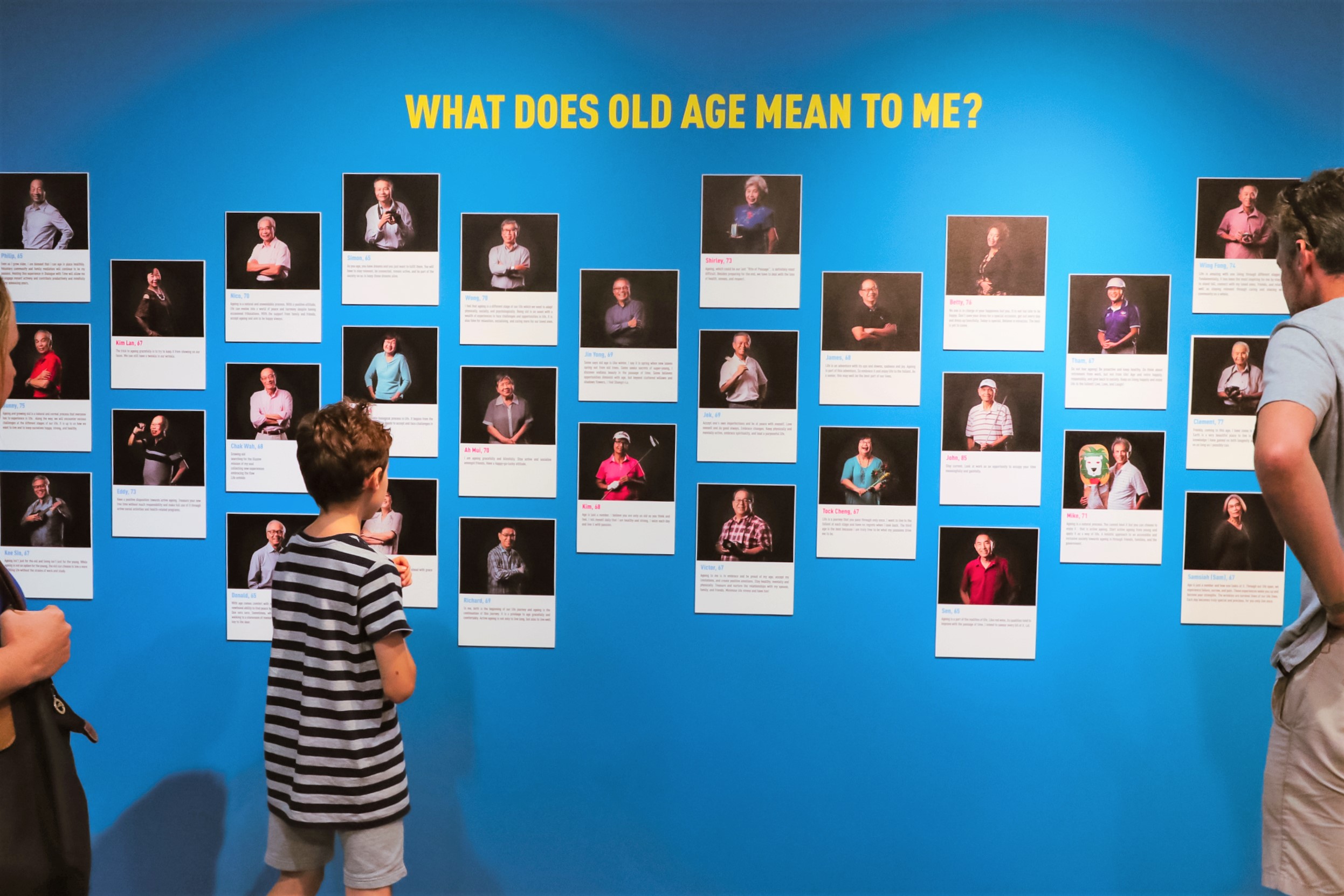
By 2030, 1 in 4 Singaporeans will be 65 years old and above. Curious to discover more about ageing and this demographic shift? Visit Science Centre Singapore’s Dialogue with Time exhibition to learn what happens to our skin, bones, and muscles as we get older and explore the social aspects of ageing populations. Hear personal reflections from our senior volunteer guides, interact with exhibits on the biological and physiological aspects of ageing, and debunk misconceptions about growing older in our nostalgic kopitiam setting. Admission tickets available here.
Written by Jamie Uy
Illustrated by Jansen Michelle
Published 27 January 2026