

Which Street Shade Actually Keeps You Cool?
A Singapore study finds that combining natural shade with artificial shade structures provides the most effective street cooling, limiting extreme heat stress exposure by up to 92%.
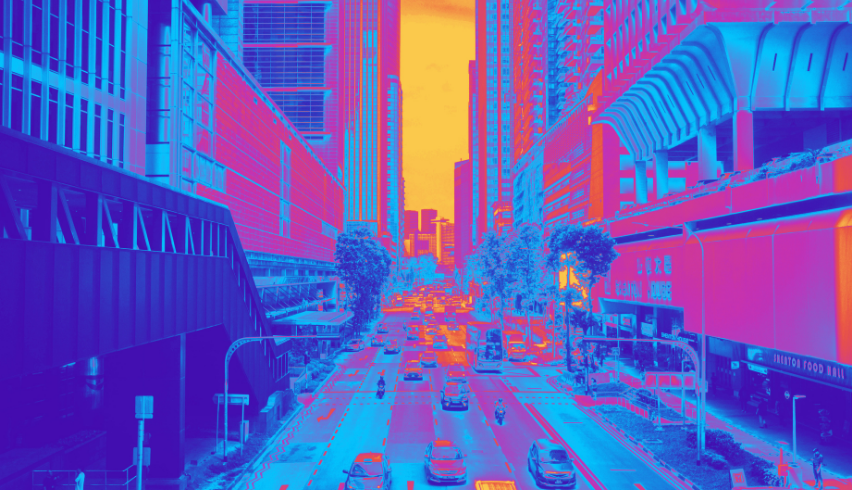
Photo of a street in Singapore’s Central Business District edited with a heatwave effect.
Picture this: you're rushing to the hawker centre for lunch on a sweltering afternoon, and you spot two options for shade: a big tree or a bus shelter. Which one should you choose? A 2024 Singapore study has the answer, and it might surprise you.
An inter-university team of researchers led by the Cambridge Centre for Advanced Research and Education in Singapore (CARES) conducted the first comprehensive study in Singapore comparing how different types of street shade (such as trees, artificial structures, and mutual shading from buildings) perform at keeping pedestrians cool. Their findings could reshape how we design our cities and navigate our daily routes to beat the heat.
Singapore's tropical climate regularly exposes residents to intense outdoor heat. With extreme temperatures becoming more common due to climate change, understanding effective cooling strategies is vital for public health.
"If we are serious about climate resilience, we must treat street shading as essential infrastructure, particularly for vulnerable communities who rely on public space,” says Prof. Ronita Bardhan, Professor of Sustainable Built Environment and Health at the University of Cambridge.
Prof. Bardhan supervised the street shade study which was initiated by Dr. Lei Xu when he was a visiting researcher in her research group, the Cambridge Sustainable Design Group. The data collection was led by the Future Cities Laboratory (FCL) Global at Singapore-ETH Centre.
Summarising the key findings from the study, Prof. Bardhan emphasised, "Street shading is not marginal, it meaningfully lowers air temperature by close to one degree and can improve perceived thermal comfort by three degrees or more, directly reducing heat stress risk in exposed populations."
The study is part of CARES' Health-Driven Design for Cities (HD4) programme, which investigates how individuals live and move in Singapore, how the urban environment shapes their exposure to health risks and how this influences their behaviour and health outcomes.
The HD4 programme will integrate environmental data with health and behaviour data in the SG100K cohort study, helping us understand how we might change the organisation of cities to make them healthier for all. The research is supported by the National Research Foundation, Prime Minister's Office, Singapore under its Campus for Research Excellence and Technological Enterprise (CREATE) programme.
Heat Detectives at Work
To cool our cities, we first need to measure just how hot our streets really are. However, heat stress has become so severe that even studying it puts researchers at risk.
To protect surveyors and minimise equipment malfunctions due to overheating batteries, the team scheduled their data collection between 2:00-4:00 PM, rather than during the hottest part of the day. Prof. Bardhan hopes the study serves as a “first proof of concept” of protocol design for similar urban heat studies to collect the best data possible while ensuring safety of participants and equipment.
Researchers set up monitoring equipment such as panoramic and thermal image cameras along with heat stress trackers to collect data along selected routes in Singapore's one-north district during a particularly hot August afternoon in 2023. They measured air temperature, relative humidity, and "view factors" — essentially the percentage of sky visible from a particular spot, which is used to calculate solar radiation.
The results were striking: street shade reduced air temperatures by about 0.8°C on average, but the perceived cooling effect was much greater, with an average decrease of 3.1°C according to the Universal Thermal Comfort Index (UTCI).
More importantly, shade dramatically reduced heat stress exposure. Street shade limited 92% of extreme heat stress occurrences and provided a 91% reduction in areas that would otherwise experience strong heat stress. By actively preventing exposure, the researchers found that shade reduces very strong heat stress by 20% and strong heat stress by 12%.
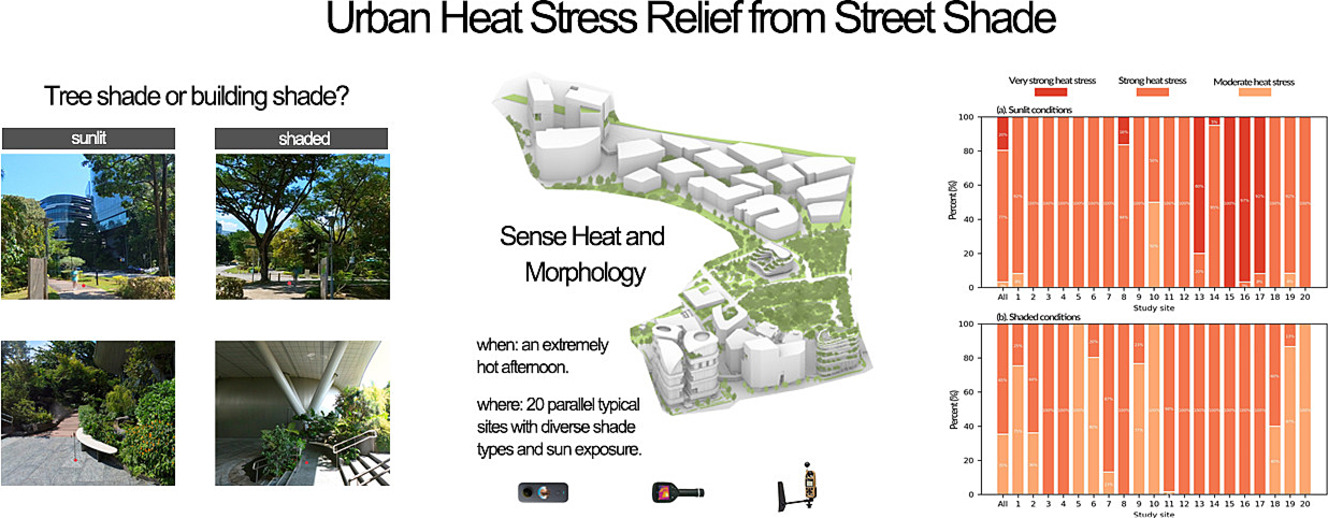
The graphical abstract from Xu, L., Bardhan, R., Mei, H., Gopalakrishnan, S., Zheng, X., & Schroepfer, T. (2025). Harnessing street shade to mitigate heat stress: An in-situ parallel investigation under extreme heat conditions in Tropical Singapore. Science of The Total Environment, 958, 177864. https://doi.org/10.1016/j.scitotenv.2024.177864.
The Winning Combination
So back to that hot lunchtime route dilemma — take shelter under a tree, or a bus shelter? The answer is both. The study found that combining different shading strategies works best.
“Shade works best when it is layered,” Prof. Bardhan explains. “Be close to a tree for natural cooling, and under a constructed shade for direct sun protection. Together, they significantly reduce heat exposure.”
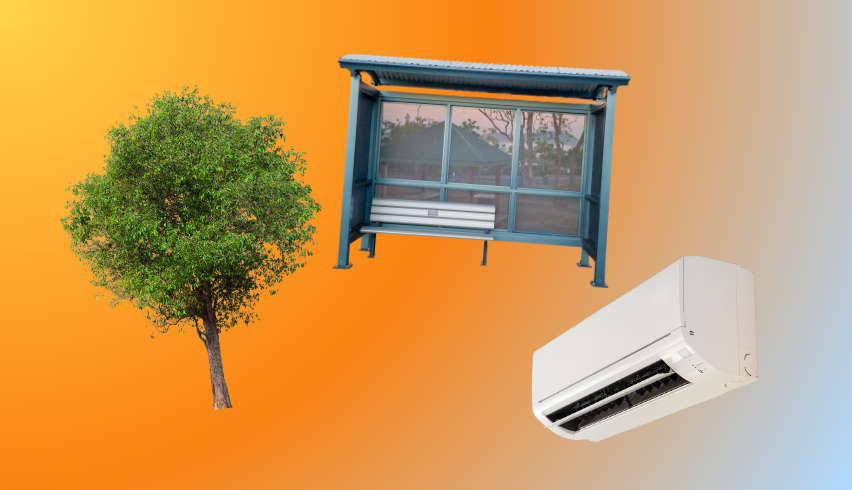
Collage of a tree, a bus shelter, and an air conditioner against an orange-blue gradient background.
This is because trees and artificial structures cool differently. Trees enhance ventilation and air movement, while artificial shading reduces surface temperature and reflected heat. The magic happens when you combine them, like that bus shelter with a large tree right next to it.
The researchers discovered that areas with high shade coverage — about 80% coverage from either greenery or large overhangs — provided the strongest cooling effects, with potential temperature reductions of 3-5°C. However, since achieving this through tree planting alone could take decades, the researchers recommend strategically deploying a diverse mix of shade types.
Smart City Planning
The findings have immediate implications for urban planners and everyday Singaporeans alike. For planners, the study suggests moving away from blanket interventions across the city. Instead, they should use "view factor" analysis — basically calculations of how much sky is visible from street level — to identify hotspots.
"If you can see more of the sky and less of buildings and greenery, you can be rest assured that that area will turn into a hotspot on a hot summer day," Prof. Bardhan explains.
The research also emphasises material choices. Surface temperatures significantly affect cooling efficacy, so selecting appropriate materials for pavements and shading structures matters. The team recommends more permeable pavements that integrate green elements without compromising walkability.
For the public, the study offers practical guidance for route planning. Understanding which areas experience higher heat stress can help people make better choices about destinations and pathways. The key is looking for combinations: sheltered corridors with nearby trees, footbridges adjacent to greenery, or pavilions in tree-lined areas.
The Road Ahead
This research represents just the beginning of a larger effort to find sustainable solutions for climate-resilient cities enhancing health and wellbeing. The study is the first publication to emerge from the HD4 programme, which Prof. Bardhan notes is “probably the only project in the world today that is looking at this intersection [of the built environment and public health] in such an intrinsic way where we are actually linking to health outcomes.”
For Prof. Bardhan, this work is deeply personal. Her vivid thermal memory of growing up in one of India’s most densely populated cities continues to shape her research agenda and her commitment to protecting climate vulnerable populations.
“I want to understand how built environment decisions can enable precision prevention for health,” she says. “I have seen firsthand how prolonged heat exposure leads to serious health consequences. What concerns me most are the communities who cannot access cooling, who cannot retreat into air-conditioned spaces or vehicles. For them, the street, the home, and the neighbourhood become their primary line of defence. That is where design must intervene.”
This focus on equity shapes the research's broader ambitions: designing cities that promote health for everyone through their very structure, while reducing reliance on energy-intensive solutions.
The team sees Singapore as uniquely positioned to lead this global effort. "If Singapore can be a forerunner in these interventions, the world will pick it up," Prof. Bardhan says, pointing to the island nation's combination of tropical climate, urban density, and strong government support for evidence-based policy.
Urban transformation starts with understanding what works on the ground. So next time you're planning that lunch route, remember: the best shade isn't just about coverage — it's about combination. Your ideal refuge combines the ventilation benefits of trees with the surface cooling of artificial structures. Science has spoken, and it says that bus shelter next to the tree is your best bet.
Explore Cities of the Future at Science Centre Singapore
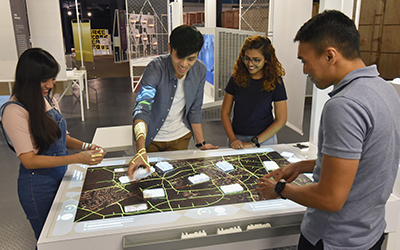
Visitors interacting with a tabletop exhibit at the Urban Mutations exhibition at Science Centre Singapore.
Want to discover other ways cities are evolving to meet tomorrow's challenges? Visit Urban Mutations: The Changing Faces of Cities at Hall A of Science Centre Singapore, a permanent exhibition on the transformation of cities worldwide developed in partnership with Universcience. Explore urban solutions championing sustainability, smart technologies, diversity, and greening. Create your own city plan and reflect on how your choices as a resident play a role in building the city of tomorrow. Science Centre Singapore attraction tickets are available here: https://tickets.science.edu.sg/.
Written by Jamie Uy
Special thanks to the Cambridge CARES HD4 programme team for facilitating this interview
Published 12 February 2026