
The Science Behind the Silver Screen
Explore the science of cinema, from silver screens to 3D glasses and dome theatres. Visit Science Centre Singapore to experience it hands-on.
As the Oscars roll around, grab your popcorn and go behind-the-scenes to discover the technology, chemistry, and physics behind movie theatre magic.

Silver Screen: The Shiny Origins of Cinema
You've probably heard the phrase "silver screen" associated with cinema. Since the 1920s, the term has become synonymous with the entire film industry (opens in new tab). While this catchy phrase may seem like just advertising hype, it actually originates from early film projection technology (opens in new tab).
In the early 20th century, movie screens were typically basic white cloth sheets. To enhance image clarity, film projectionists began experimenting with coating the screen surfaces with silver, aluminium, or other metallic paints. Silver’s superior reflective properties resulted in sharper and brighter images. (opens in new tab) Industry innovators like Harry C. Williams (opens in new tab) popularised vinyl plastic silver screens (which were more durable than the cloth versions) in the United States of America throughout the 1950s. Following the advent of "talkies" (movies with synchronized sound), film projectionists further improved silver screens. Screens were perforated with tiny holes (opens in new tab) allowing for clearer sound from speakers positioned behind the screen.
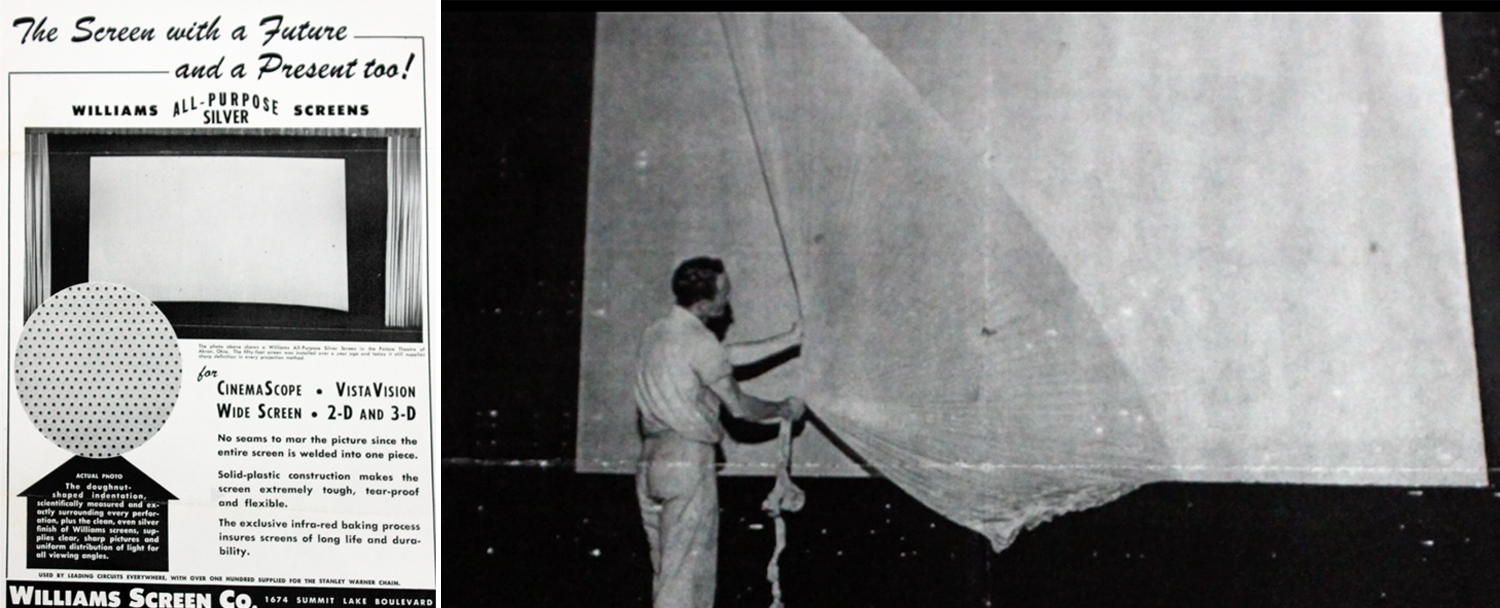
Left: An advertisement for silver screens from Williams Screen Co. Right: Photograph of Willams’s tear-proof silver screen. Source: PBS/Around Akron with Blue Green (opens in new tab)
The association between silver and cinema also links back to the chemistry of early filmstrips, which used "microscopic reactive silver salts (opens in new tab).” Kodak's first commercially available photographic film roll in 1889 (opens in new tab) used cellulose nitrate (opens in new tab), a film stock that contained an emulsion composed of silver halide compounds that reacted when exposed to light. Cellulose nitrate was renowned for its "luminosity and metallic lustre" (opens in new tab) and "jewel-like" (opens in new tab)colours. However, it was also highly flammable (opens in new tab), prompting manufacturers to pursue safer film bases after the 1950s.
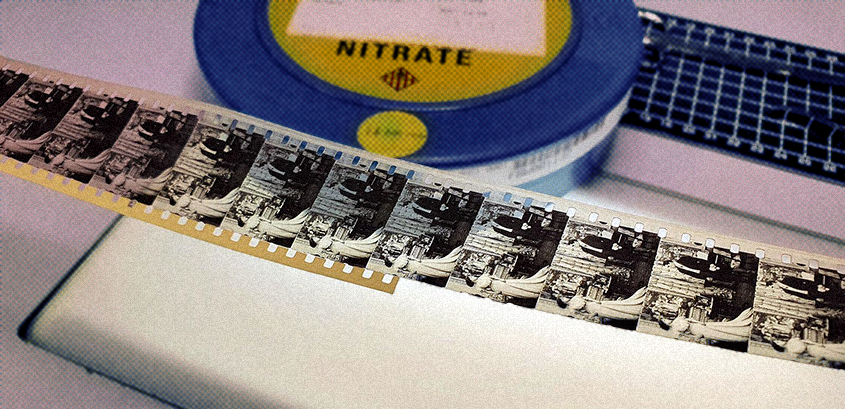
Photograph of nitrate film. Original photo source: National Film and Sound Archive of Australia, (opens in new tab) edited by Ai Xin Qin
Today, cellulose nitrate is classified as dangerous and carefully handled by film archivists. Silver screens have replaced largely by matte white screens (opens in new tab) offering better viewing angles and colour accuracy, although their highly reflective properties remain useful for 3D movies. Nevertheless, the phrase "silver screen" endures, signalling cinema's technological evolution.
3D Movies: Tricking Your Brain
How do 3D movies create eye-popping effects, transporting viewers right into the scene? To understand how 3D movies work, we must first grasp stereoscopic vision - our brain’s ability to "interpret visual information from both eyes to create a clear three-dimensional (3D) image.” (opens in new tab)
Try this one-minute experiment. Close your right eye and focus on a distant object with your left eye. Then switch. Notice how the position of the object appears to shift slightly depending on the eye? Our brains evolved to process these slightly different 2D images into a single 3D image. The optic nerve transmits both images to the brain's visual cortex, which uses the differences to determine the object's distance (opens in new tab).
3D movies take advantage of stereoscopic vision by delivering a different image to each eye (opens in new tab). Our brains fuse these two 2D images into a 3D spectacle, of say, Godzilla stomping in the sea, with the ferocious waves appearing to splash mere metres away from our seat.
While 3D movies may seem modern, the basic components of 3D film technology dates back to the 1830s (opens in new tab). The first commercially released 3D feature film The Power of Love (opens in new tab) premiered in 1922. 3D movies were shot with two cameras or one twin-lensed camera (opens in new tab) with lenses spaced 6.3 centimetres apart, roughly the average distance between a person's eyes. The two images from the camera were then projected simultaneously onto the screen. To view early 3D films, audience wore white cardboard red/blue or red/green glasses known as anaglyph glasses (opens in new tab). These 3D glasses used colour to filter the image (opens in new tab) for each eye; for example, the red filter only let red light through, while blue filter only let blue light through.
However, anaglyph glasses produced fuzzy images, and the colour of the picture was always a bit off. In 1936, Edwin Land invented polarized lenses that "worked with full colour.” (opens in new tab) Cinemas switched to polarized 3D glasses (opens in new tab) that use light's direction, rather than colour, to filter images for each eye. One image is polarized vertically, the other horizontally. Like anaglyph glasses, the viewer's brain then did the magic of combining both images into 3D.
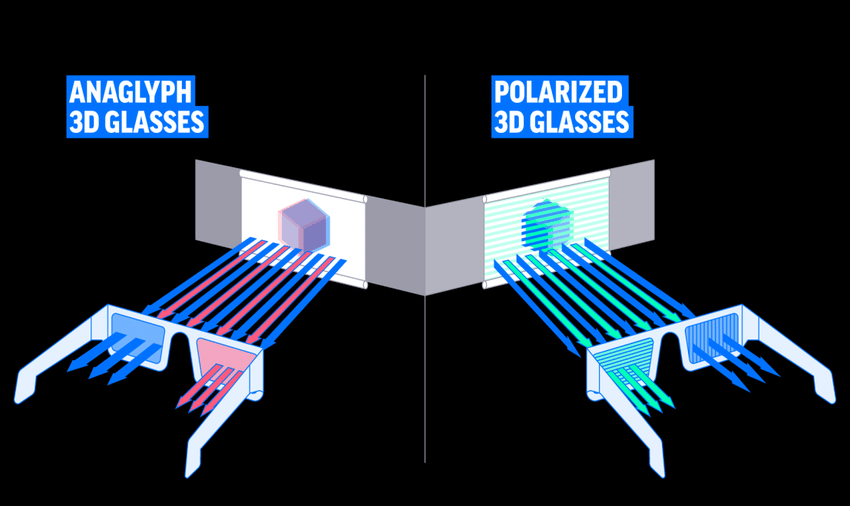
Diagram contrasting view of anaglyph and polarized 3D glasses. Source: Laghari et al. (2021) (opens in new tab)
While 3D movies might be considered a novelty gag, the 2000s saw another 3D renaissance with James Cameron’s Avatar. According to Popular Mechanics (opens in new tab), Avatar pioneered new technologies such as a 3D camera that presented an augmented-reality view by "integrating the live actors into CG environments on the viewfinder.” Today, even 2D movies can be converted to 3D using computer software.
Dome Theatres: Immersion Maximised
What's better than the big screen? An even bigger screen! Dome theatres like IMAX's Omnimax theatres push the boundaries of immersion with giant, curved screens that engulf the audience. Omnimax theatres feature steeply inclined seats up to 30 degrees and use an ultra-wide lens (also known as a fisheye lens) projection system in the middle of the seating area to create a panoramic experience (opens in new tab) for the moviegoer.
Singapore's only immersive dome theatre, located at Science Centre Singapore, boasts Southeast Asia’s largest seamless dome screen (opens in new tab) with a diameter of 23 metres (opens in new tab). Completed in 1987, the Omni-Theatre features “a massive hemispheric screen tilted at a 30° angle to the horizon … covering 80% of the hemisphere” according to 50 Years of Science in Singapore (opens in new tab). For the average viewer, the screen fills nearly their entire field of view (opens in new tab), including peripheral vision where motion detection is particularly sensitive. This creates an uncanny sense of really flying through space, trekking through rainforests, or scaling mountains.
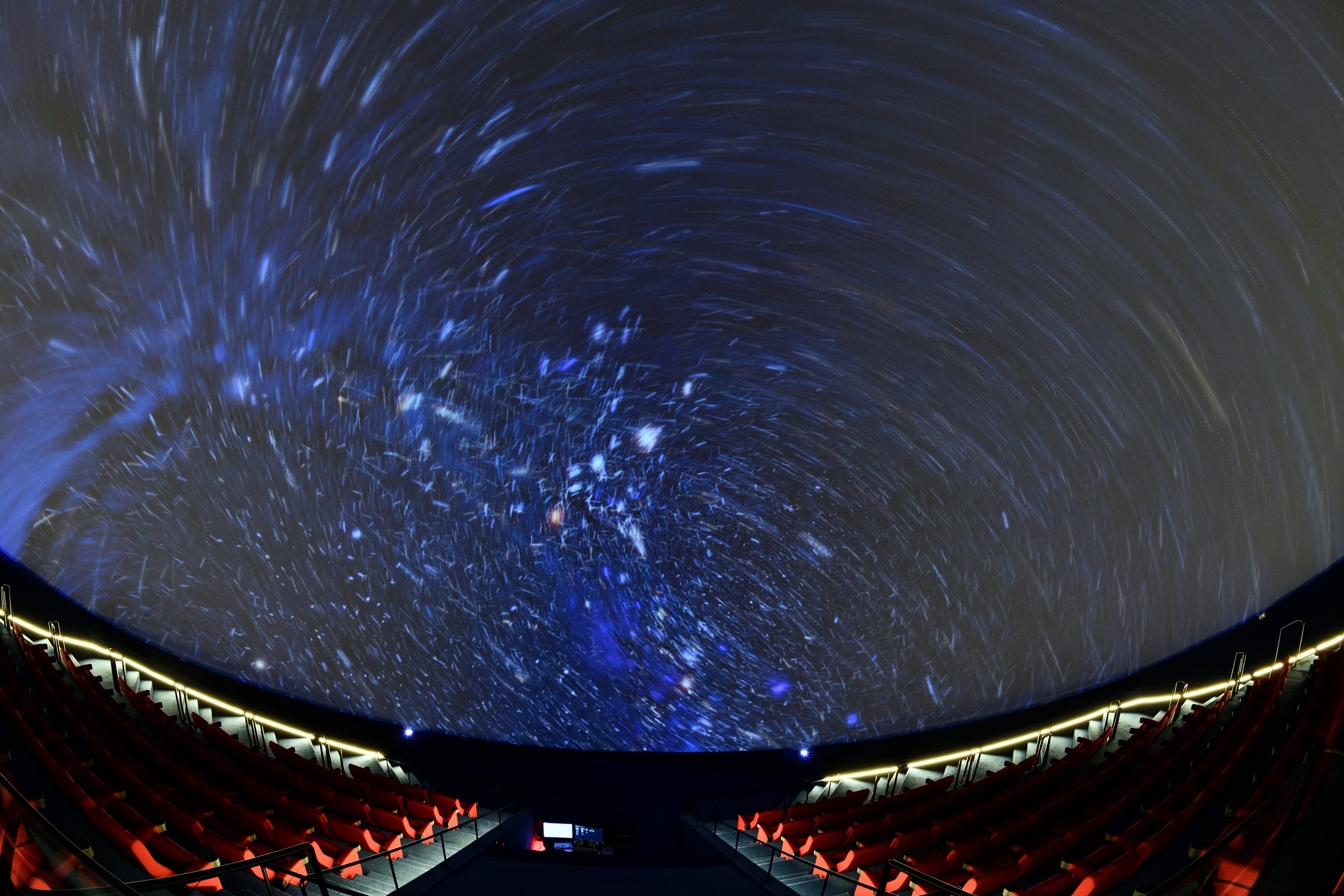
Photograph of Science Centre Singapore's Omni-Theatre dome screen. Source: Science Centre Singapore
In 2015, the Omni-Theatre upgraded to an 8K digital planetarium projector system featuring five Christie Mirage 304K projectors (opens in new tab). This system includes a real-time science and astronomy database, allowing educators to show stunning, ultra-high resolution visuals of the night sky from any date at the click of a mouse. Want to see the awe-inspiring Omni-Theatre dome screen yourself? Movie tickets are available here (opens in new tab).
Lights, Camera, Science!
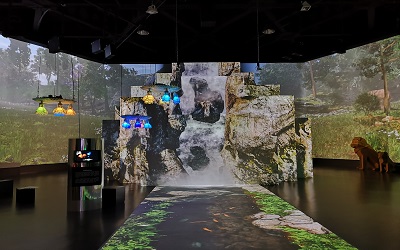
E3 exhibition at Science Centre Singapore. Source: Science Centre Singapore
Discover hands-on exhibitions exploring the scientific principles behind movies at Science Centre Singapore (opens in new tab). The evolution of cinema technology continues at our exhibition E3 - E-mmersive Experiential Environments (opens in new tab) featuring virtual reality headsets and 360-degree projection mapping. Step into immersive environments built using the Unreal game engine and projection-mapped onto walls using real-time 3D rendering technology. Explore larger-than-life virtual forests, oceans, and galaxies.
For a glimpse into cinema's past, pop by The Giant Zoetrope (opens in new tab) exhibition showcasing a three-dimensional structure based on Victorian-era pre-film animation devices. Press the button to spin the zoetrope under strobe lights and watch static images come to life in an illusion of continuous movement!
As you settle into your seat for the next blockbuster, remember - you're not just watching a movie, you're experiencing the sequel to over a century of scientific progress, one frame at a time.
Written by Jamie Uy
Featured illustration by Ai Xin Qin
Last updated 28 February 2025