
Romance in Bloom: All About Roses
Discover the rich history and plant science behind roses this Valentine's Day. Visit Science Centre Singapore and enjoy special promotions for the perfect romantic outing.
Love is in the air, and so is the sweet fragrance of roses. This Valentine's Day, get to know the horticultural origins and plant science behind this cherished bloom.

Graphic created in Canva.
Roses have long symbolized Valentine's Day, even more than heart-shaped chocolates or cuddly teddy bears. The trade group Society of American Florists estimates that more than 250 million roses (opens in new tab) alone are produced just for 14 February. This captivating bloom garners big bucks: the international rose trade market amounted to 4.58 billion USD (opens in new tab) in 2020.
Let's get to the roots of these beautiful plants, tracing their journey from ancient origins to modern-day symbols of love.
How did the tradition of giving roses for Valentine’s Day start? In 19th-century England, it became fashionable to send elaborate floral bouquets as secret messages (opens in new tab). Each flower and colour was paired with a particular emotion, with red roses signifying love.
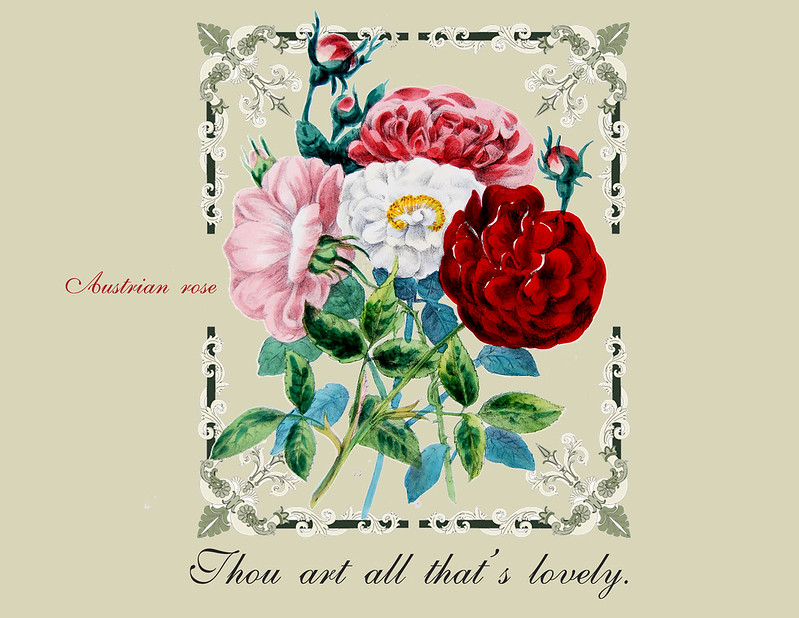
An illustration of an Austrian rose from a Victorian-era flower dictionary, signifying "thou art all that's lovely." Source: Mann Library/Flickr (opens in new tab)
Since red dye was expensive at the time, red roses were also associated with luxury (opens in new tab). Botanists experimented with new rose varieties to meet consumer demands.
One famous rose cultivar is the American Beauty Rose. Bred by Henri Lédéchaux in France in 1875, the American Beauty spread across the northeastern United States with its deep pink and crimson colours. Bestowed with the nickname “millionaire’s rose” (opens in new tab)for its hefty price in the 1800s, this classic variety continues to be a popular Valentine’s Day purchase to this day.
The scientific definition of a rose is a woody perennial flowering plant in the genus Rosa (opens in new tab). The Rosa genus includes approximately 100 species of perennial shrubs in the rose family Rosaceae (opens in new tab). Roses are closely affiliated with several other economically important members in Rosaceae, from food crops like almonds (Prunus dulcis) and strawberries (Fragaria species) to ornamentals like hawthorns (Pyracantha species) and crab apples (Malus species).
While the Valentine’s Day rose-gifting tradition may have flourished in Europe, most rose species are native to Asia (opens in new tab). According to fossil records, roses originated in Central Asia approximately thirty million years ago (opens in new tab).
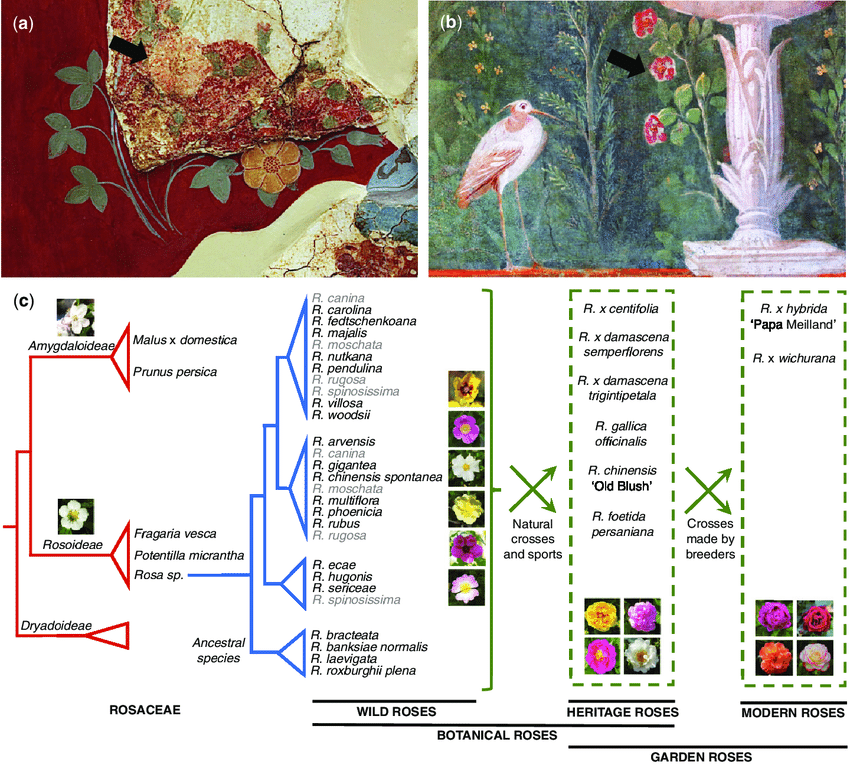
Fig. 1 from Conart et al. (2022) (opens in new tab) providing an overview of the evolution of the Rosaceae family and of the Rosa genus. (a) Antique murals in (∼1,700 B.C.). Arrow shows the original drawing of a wild rose (the other drawing was made during an irreversible restoration). (b) Antique murals in Pompei (∼79 A.C.). Roses were painted with dozens of petals (arrow). (c) Synthetic phylogeny and evolution diagram obtained by simplification of data from Fougère-Danezan et al. (2015) (opens in new tab), Zhu et al. (2015) (opens in new tab), Xiang et al. (2017) (opens in new tab), Zhang et al. (2017) (opens in new tab), and Debray et al. (2019) (opens in new tab).
Ancient civilisations (opens in new tab) like the Chinese, Egyptians, Greeks and Romans helped pioneer rose cultivation. In fact, the first rose garden (opens in new tab) was created in China 5,000 years ago, and Chinese garden roses as old as the Song Dynasty are the ancestors of modern roses (opens in new tab). Early roses (opens in new tab)had "five-petaled flowers, distinctive oval serrated leaves and colourful hips," qualities that persist in contemporary wild rose species. Today there are over 300 species of roses and tens of thousands of cultivars (opens in new tab) bred for unique colours, shapes, sizes, growth habits, and scents.
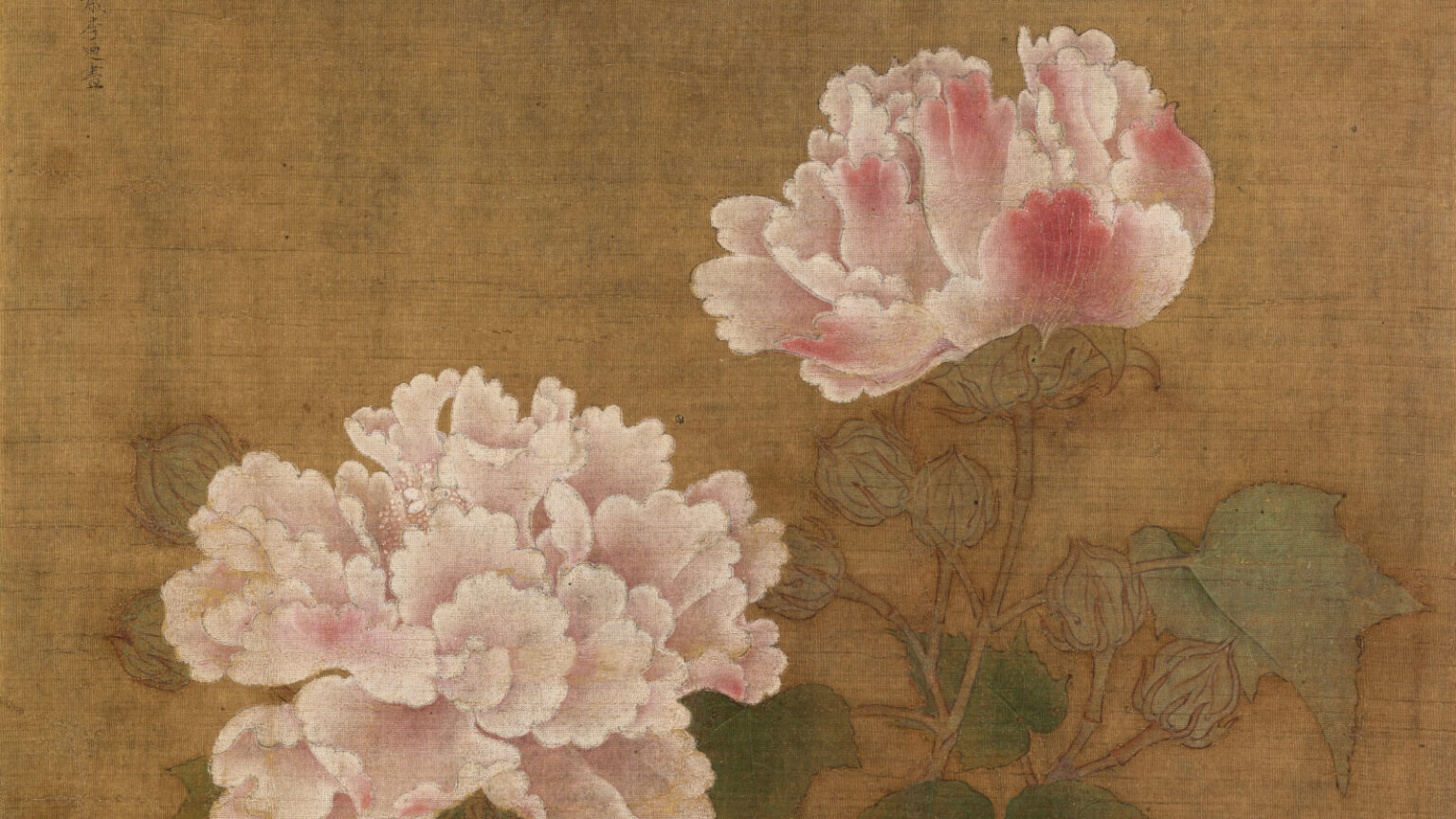
Detail of Li Di's Red and White Cotton Roses from 1197 AD, color on silk, Tokyo National Museum, Tokyo, Japan. Source: Daily Art Magazine (opens in new tab)
While English idioms like “there is no rose without a thorn” are common and there are countless songs about the barbed nature of this flower of love, roses actually don’t have thorns (opens in new tab). Strictly speaking, in botanical language, those pokey bits sticking out from the stem are actually prickles.
What’s the difference? In plant science terms, thorns refer to the “sharp woody points of certain shrubs and trees”, while prickles “form from the skin of the plant, similar to how hair grows” according to CNN (opens in new tab). These prickles help defend roses (opens in new tab) against animals who would otherwise chomp on them.
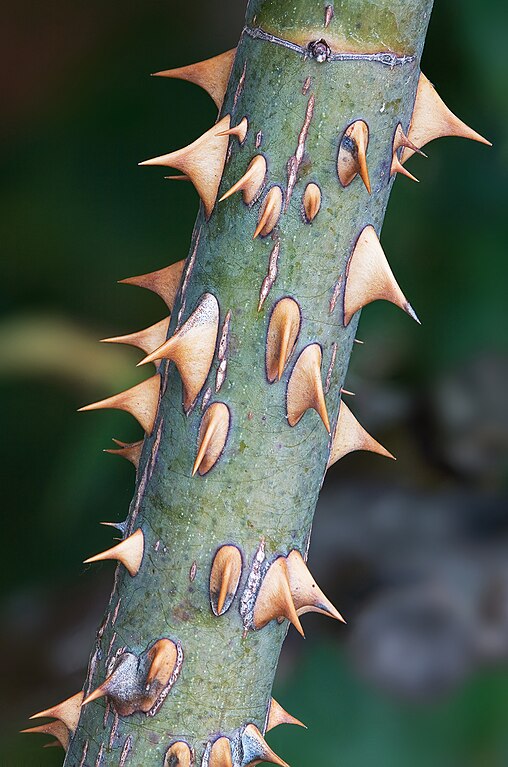
Rose prickles. Photo credit: JJ Harrison/Wikimedia Commons (opens in new tab).
If finding your life partner is a thorny subject for you this Valentine’s Day, you may find comfort that you’ll never truly be alone in the fascinating world of plant genetics. Recent research has uncovered how similar features like prickles emerge amongst unrelated plant species. A 2024 study published inScience (opens in new tab) concluded that one ancient gene family called "Lonely Guy" is responsible for the prickles in many diverse plants such as roses and other key crops such as wild eggplant, cucumber, and rice (opens in new tab) that evolved over millions of years. Quite an impressive legacy for a "Lonely Guy"!
While roses have developed prickles and showy, vibrant flowers, they've also developed features that make them irresistible to humans beyond their visual appeal. These versatile plants have found their way into our culinary traditions, proving that roses can be a feast for both the eyes and the palate.
Rose hips (opens in new tab)—the berrylike floral cup which contains the rose’s seeds—are high in vitamin C and natural sugars. These nutritious fruits were a valuable ingredient during World War II (opens in new tab) for syrups. But the culinary uses of roses don't stop there. Rose water—water flavoured by being steeped in rose petals—is used to cook delicious South Asian sweets like laddoo and gulab jamun. In Singapore and Malaysia, the bright pink, refreshing bandung beverage is made by mixing evaporated milk or condensed milk with rose syrup or cordial.
From their ancient origins to modern cultivation, roses continue to enchant both scientists and romantics alike. Beyond being symbols of love, roses are living chronicles of cultural exchange and scientific discovery.
Celebrate Valentine's Day at Science Centre Singapore
This Valentine’s Day, gift your special someone everlasting memories uncovering the marvels of science! Visit Science Centre Singapore and enjoy our Feb-ulous 1-for-1 ticket promotion (opens in new tab)from 1 Feb 2025-14 Mar 2025. Stroll through our living laboratory of flora and fauna at the Ecogarden, journey through a whimsical village of carnivorous plants in Savage Garden, and let sparks fly as you watch our electrifying Energy Titans Show.
If you fancy a date to outer space instead, snag our Valentine's Day two-tickets bundle for Space Explorers: THE INFINITE (opens in new tab) from 14-16 February and get a pair of limited-edition International Space Station t-shirts. Be transported 400 km above Earth in the world's largest immersive space exploration experience and witness romance beyond the stars. Wishing you a wonderful, rosy Valentine’s Day!
Written by Jamie Uy
Last updated: 14 February 2025