
Every Ripple Counts: A Conversation for Ocean Conservation
At the heart of the fireside chat was a surprisingly simple question: why do so many people feel disconnected from the ocean, even in a city surrounded by water like Singapore?
As the lights dimmed ahead of the public opening of One Ocean, Every Action Ripples at Science Centre Singapore, Chief Executive Tham Mun See posed a simple but urgent idea: the ocean may feel distant, but its ripples reach every part of our lives. Developed in partnership with Tara Ocean Foundation and produced by RideFX, the new exhibition transforms two decades of ocean science into an immersive, multi-sensory journey — from coral reefs and Arctic ice to microscopic plankton and Singapore’s own marine waters. But beyond the spectacle lies a deeper mission: to reconnect people with the ocean and remind us that every choice we make on land shapes life at sea. That message carried into the opening fireside chat, where scientists, conservationists and technologists gathered to explore how research, storytelling and innovation can inspire collective action for the future of our oceans.
Meet our Panelists
Elia Vermander, Executive Producer, RideFX.
Dr Toh Tai Chong, Marine Biologist and Lecturer, National University of Singapore.
Dr Siti Maryam Yaakub, Senior Director, International Blue Carbon Institute, Conservation International.
Sébastien Ruiz, Secretary General, Tara Ocean Foundation
Kelly Latimer, Host and Moderator
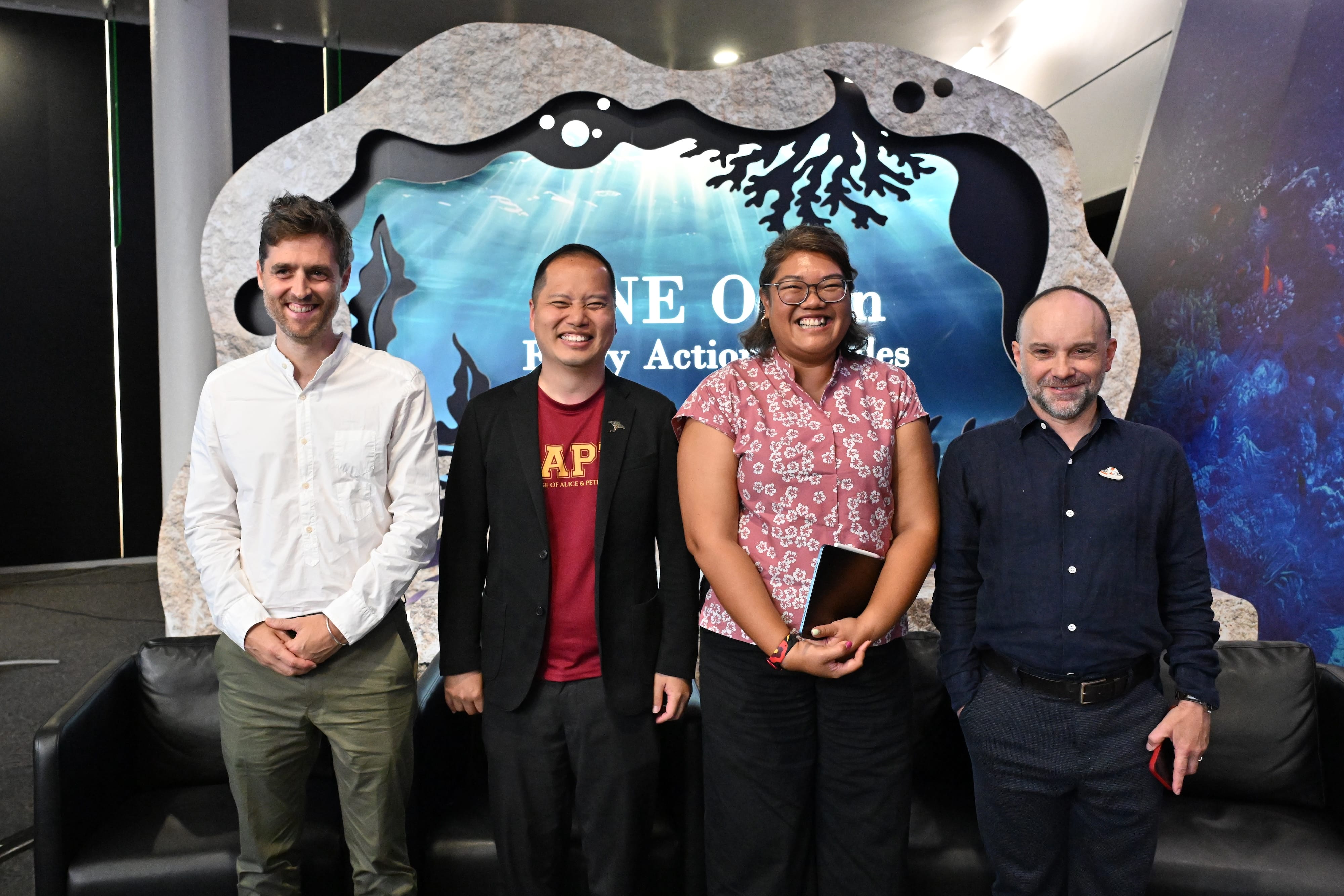
(From Left) Mr Vermander, Dr. Toh, Dr. Siti, and Mr Ruiz
Key Takeaways
At the heart of the fireside chat was a surprisingly simple question: why do so many people feel disconnected from the ocean, even in a city surrounded by water like Singapore?
For the panelists behind One Ocean: Every Action Ripples, the answer lies partly in distance, but also in perception. The ocean often feels abstract, intimidating or out of sight, despite shaping nearly every aspect of human life — from climate and biodiversity to food systems and coastal survival.
“We identify ourselves as city folks,” said marine biologist Dr. Toh Tai Chong. “Nobody says, ‘I am an islander.’”
That disconnect, however, is becoming harder to ignore.
With rising temperatures and sea levels increasingly affecting Singapore, the discussion repeatedly returned to the idea that ocean conservation is no longer a niche environmental issue, but a deeply personal one. The panel stressed that Singaporeans often overlook the marine ecosystems in their own backyard, including coral reefs, seagrass meadows and mangroves that quietly support biodiversity, food security and climate resilience.
Dr. Siti Maryam Yaakub highlighted the role of “blue carbon” ecosystems such as mangroves and seagrass, which absorb and store vast amounts of carbon while also protecting coastlines from storms and erosion. These ecosystems, she explained, are not distant environmental concepts but part of everyday Singaporean life. She even highlighted Singapore’s national dish, chilli crab.
“If there are no mangroves,” she joked, “there will be no mud crabs.”
The conversation also explored how storytelling and immersive technology can bridge the gap between scientific research and public understanding. Rather than presenting visitors with scientific reports and data sheets, the exhibition translates decades of ocean science into sensory experiences designed to spark curiosity and emotional connection.
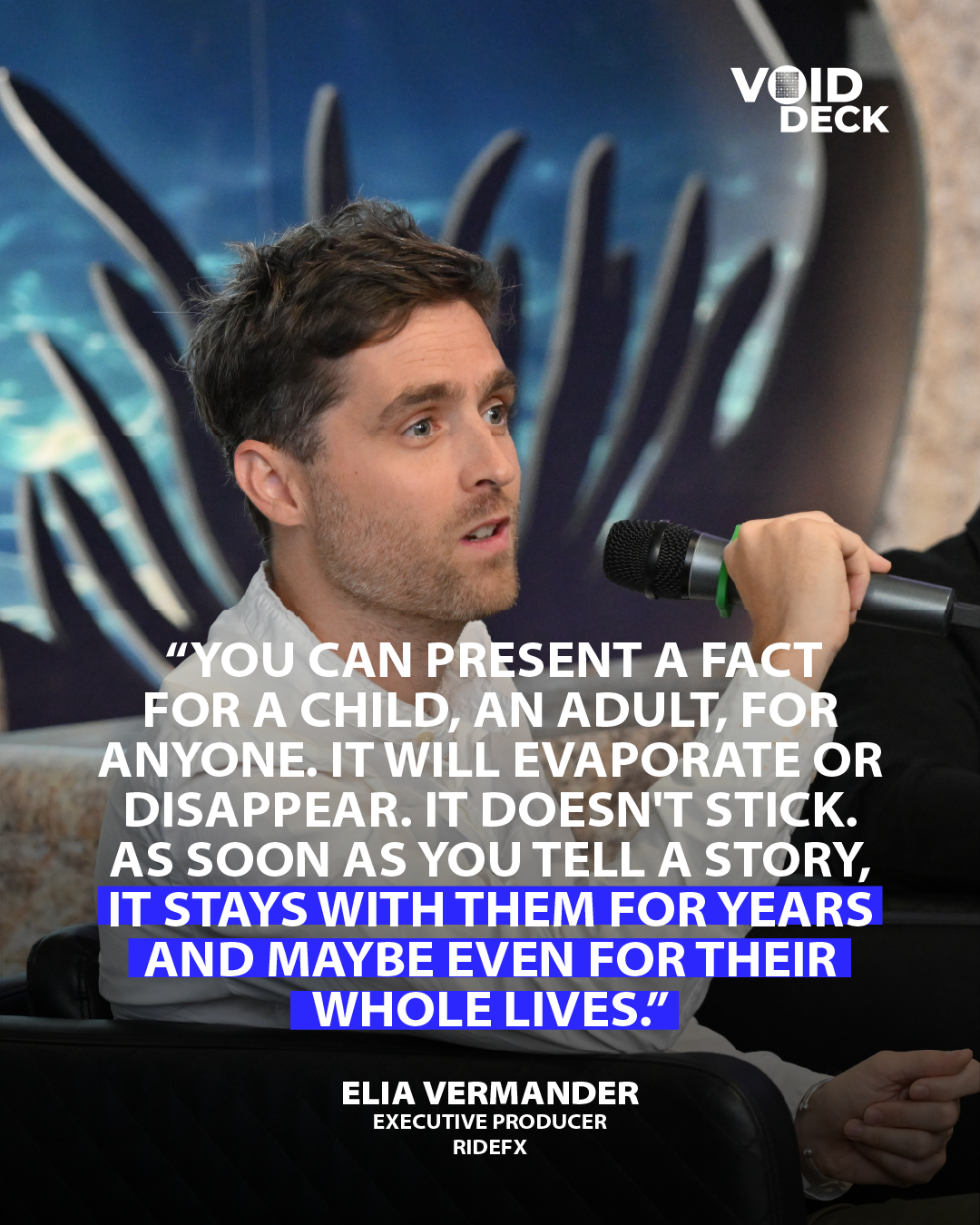
For Elia Vermander of RideFX, emotion is essential to education. “You can present a fact for a child, an adult, for anyone. It will evaporate or disappear,” he said. “As soon as you tell a story, it stays with them for years and maybe even for their whole lives.”
That philosophy shaped the exhibition’s immersive environments, from giant whale projections and holographic plankton to VR deep-sea dives guided by a miniature submarine named Yellow. Every visual spectacle, however, was grounded in scientific accuracy — something Sébastien Ruiz said remained central throughout the collaboration with Tara Ocean Foundation.
“Science is not an opinion,” Ruiz said. “Truth is not an opinion.”
Still, the panel ultimately returned to a human message rather than a scientific one: that meaningful environmental action often begins small. From joining beach clean-ups and nature walks to simply becoming more aware of local ecosystems, the speakers emphasised that collective change is built through everyday choices and shared responsibility.
Or, as the exhibition’s title reminds visitors: Every Action ripples.
Full Transcription
This transcription has been edited for easy reading.
Kelly Latimer:
One ocean is built around the idea that the ocean connects all of us, even people who may not find themselves next to it in their daily lives, don't interact with it on a regular basis. Why do you think that that disconnect exists? And why is it so important to change that now? So that's what most of it is.
Sébastien Ruiz:
Good morning everyone. First, we are really proud and honoured to be in Singapore. Why are people disconnected? Maybe because this exhibition didn't exist before! [laughs jokingly] Why? Because many people live far from the sea. A huge part is because many people are afraid of the seas and oceans. There are strange creatures, it's really deep, it's dark. But as you've seen in the exhibition, many microorganisms are beautiful and sometimes tiny.
Dr Siti Maryam Yaakub:
Hi, everybody. Again, thank you for having me on this panel. I think this one is really timely because it's very strange to me that as an island nation, Singaporeans are very disconnected from the sea and from the ocean. But what I see is like a sea change, if you pardon the pun. In Singapore, people are reclaiming that narrative around our connection with the sea. And I think exhibitions like this will definitely help reclaim that connection as well. But it's really important for us to sort of examine our roots as an island nation and how that connects to the sea because it's very relevant to us. It's just right next door. Anything that happens with the sea to do with climate change is going to affect us all. And I think our government is very aware of this. And it's time that people started understanding the inherent connection that Singaporeans have with the ocean.
Dr Toh Tai Chong:
Well, I think Singapore is really at an inflection point. Our temperatures are rising. Seawaters are rising too. So it's no longer just about comfort. It's really about action, trying to bring more measures that will impact future generations, our core survival of the nation. So like what Dr. Siti mentioned, I think most of us identify ourselves as city folks. If you ask around, nobody will say that I am an islander.
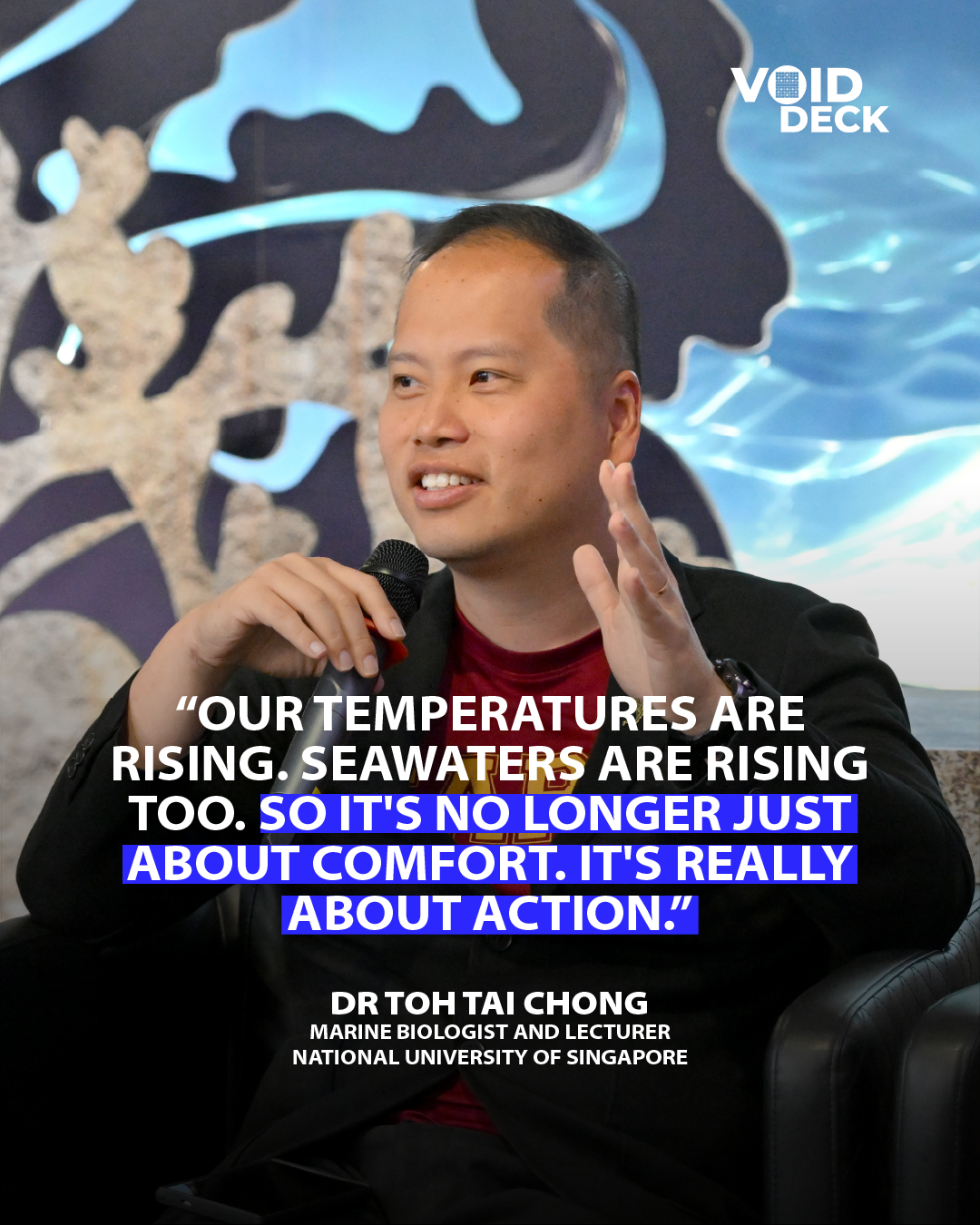
Most people would be very surprised to know that there are coral reefs here in Singapore. They'll be like, oh, I thought we need to go to Malaysia or Indonesia to find coral reefs, but we do have them in our backyard. So I think disconnect exists and it is very much a function of our lifestyle, us not exploring enough, or having the difficulty in trying to reach out and see what's beyond sea level. So for this particular ocean exhibition, it really brings the ocean to people who are often not accreted or find it difficult to go underwater. So this particular part of it, especially when it comes to environmental issues, can be very, very abstract. So this breaks it down into small, bite-sized pieces to connect people who are very passionate, to connect them to issues, and to also connect them to different opportunities that they can take action. So just for example, a couple of weeks ago, I met a young secondary four student who was very keen to apply to the Republic Poly for his marine science program. And he had a full load of different information, done a lot of extensive research. And a key question that he asked was, how do I get involved? So through this particular exhibition, he was able to join as a volunteer guide. And he'll be joining the exhibition and guiding people along. And there's his small little part for the ocean in Singapore.
Elia Vermander:
The reason why there actually is such a huge connection of so many people to the ocean, is quite simple. Our planet is called the Blue Planet for a reason. 72% of our surface is covered by the ocean. The ocean is a source of mystery, of wonder, of fear, anxiety as well. It's the only ecosystem that is shared across all continents. I believe it's also a source of imagination for a lot of people because it is, as of now, also the only part on our planet that is still largely unexplored – as you will discover in this exhibition. Thanks to the Tara Ocean Foundation, and other foundations as well, we're only just beginning to discover what is the incredible wealth and richness of this huge part of our world, of our planet.
Kellay Latimer:
There's still so much out there, but I think you guys have done an exceptional job of taking those images, capturing them, and putting them on display for us to understand a little bit more.
Okay, Sébastien, we're going to come back to you because I'd like to find out, in your perspective, what has become the most urgent state of our ocean today? What is it that needs addressed and why does that urgency need to feel personal in order for people to actually feel that disconnect and for people to take it beyond? Beyond just the scientists, right? Because I think everyone here on this panel is deeply invested in it. But why would your average folk day in, day out?
Sébastien Ruiz:
We are focused on many many stuff. Science is crucial, for sure. But what we do here is really crucial, too. We need, I think, awareness. It's impossible to do without awareness. It's really crucial to speak with people, to inform. So I think we have two expeditions at the same time now. One with the Tara Coral Expedition – it's really important to know how and why coral is resistant, resilient. It's the first sentinel of the ocean.
And the second expedition is the Arctic. It's a second sentinel in the Arctic to know why climate change. I think we focused on this question, why climate change and how we can try to stop this. So awareness, it's important for that because of the data. The data is impressive and complex.
Sébastien Ruiz:
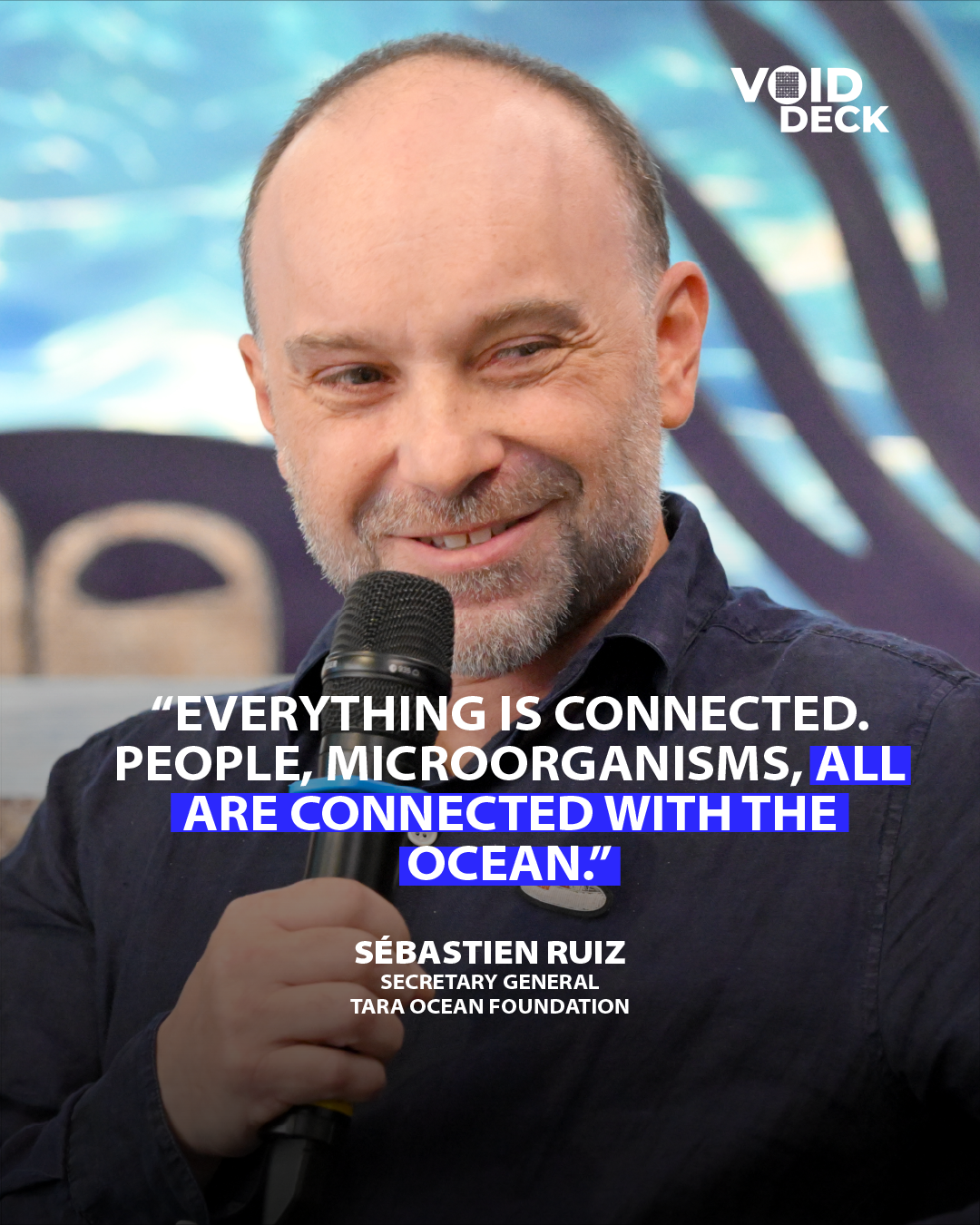
So if we want to speak with all people, we should open exhibitions like this one. That's why the title, it's the first part of the exhibition, ONE Ocean. It's really a dream for us. It's important to know that everything is connected. Everything is connected. People, microorganisms, all are connected with the ocean. Ocean, it's 70% of the blue planet, as you said. So, it's in crisis. What we can change, how we can change, to talk together, to have collective action – awareness is the first step of collective action. So I think for me, we should focus on science and awareness.
Kelly Latimer:
When we're looking at the impact that it has on your average person day to day, yeah, in Singapore, we walk around, we go, oh, it's so hot. It's getting hotter as the days go by, right? But what else is being affected? Is it our food? What else?
Sébastien Ruiz:
It's affected all, all parts of the living. All parts are affected.
Kelly Latimer:
Thank you very much, Sebastian. Dr. Toh, you talked about us identifying as a city person as opposed to an islander. And before you said that, I was thinking, you know, maybe we could liken Singapore to Motu Nui and Moana, right? We're surrounded by the ocean. We need to go out there. We need to explore the ocean a little bit more, right? But then you came back and then you said, well, hang on a minute. We identify as city people. I'm like, actually, yes. I look at my kids and my daughters and she is definitely a city kid. Because we're seen as such a highly urbanized society that many people don't actually realize that biodiversity actually exists within our own waters. I think the government's done a lot to try and rewild certain areas of Singapore, make sure that we've got green pockets, but also have waterways and water systems so that our longkangs are not just longkangs anymore, they're actual pathways for biodiversity to thrive. But why is it important for Singaporeans to have that connection, to better understand it, and also to care about our local marine ecosystem?
Dr Toh Tai Chong:
Well, I think most Singaporeans wouldn't realise that we are actually sitting in a treasure trove of marine biodiversity. So for example, we have about 250 hard coral species here in Singapore. And most people will be surprised to know that it's actually about one-third of the world's coral species right here, right? And we have areas that are covered with corals flourishing, comparable to some tourism sites overseas. So I think these are some of the key things that are important for Singaporeans to know. And we also have endangered species. We have sponges that are hardly found, but are recently rediscovered. So there is a key ecosystem of people working behind the seas. And I think for today's exhibition, you'll find the local segment very impactful because what we are trying to do is to bring forth the people behind the conservation efforts. Coping inspires Singaporeans. People in Singapore come together to contribute. In fact, the journalists and the media friends that we have here, each of you play a very important role because you help to corporate that information out and help to reach out to common Singaporeans that are out there who might not know that we are in the backyard of a treasure trove. So for many of us, I think this is still a gap to be addressed. We hope that more people can come on board and to basically take action together collectively as a community.
Kelly Latimer:
Dr. Siti, you talked about going back to our roots, and I thought that was quite a funny, maybe unintended pun there, considering this work that you do. We talk about climate action, and a lot of us think of forests, for example, or emissions, not necessarily the ocean. Although increasingly, I think that is changing. Your work largely focus on blue carbon ecosystems, like mangroves and seagrass. Can you just explain what is Blue Carbon? What is it and why should we be caring about it and why should we see ocean conservation as climate action as well?
Dr Siti Maryam Yaakub:
Sure. Thanks for that question. So for the uninitiated, blue carbon is in the name, so there’s carbon, right? And carbon emissions are the main thing that's driving climate change to the runway. So when we talk about blue carbon, it's actually about the ocean systems as a whole that absorb and store all of this carbon. So if you look at the exhibition, I just had a look earlier, and it talks about the ocean being a physical, but also a biological pump. And when you talk about all-carbon ecosystems, we're really referring to the biological pump of this equation. So it's all of those ecosystems like seagrass and mangroves, also tidal, salt marshes, which don't really exist in the tropics.
But also like macroalgae, phytoplankton, and all of these things that actively absorb carbon from the atmosphere and store it away for the long term. It then narrows down further, and I don't want to get too technical, but when you talk about climate action, this is extremely relevant because these are ecosystems that exist along our coastlines that we can take active measures to protect and conserve. And these ecosystems, like mangrove, sea grasses, and salt marshes, can store more than rainforests per hectare, and that makes them extremely efficient in biological parts. So to answer that question, it's mostly these three ecosystems, mangroves, seagrass and salt marshes, and they can store carbon at exceptional rates. They also sit at this nexus of ocean and climate change, as well as the action that we can take to prevent that. So I think they're extremely important. I think what people don't realize is that it goes beyond multiple purposes, right? So they're also great for coastal resilience because they protect shorelines in storm surges. You'll see that there are a lot of reports about how, you know, mangroves actually buffer big storms and tsunamis.
And they also are a great trove of biodiversity. So like Dr. Toh said, you know, 200 species of hard corals. We have more than half of the species of seagrass that's available in the Indo-Pacific right here in Singapore. They are a food source to so many of the species. Did you know we have dugongs in our Singapore waters? They are like these huge sea cows.
Kelly Latimer:
I see them at Mandai all the time.
Dr Siti Maryam Yaakub:
The one you see at Mandai is actually a manatee.
Kelly Latimer:
Oh, yes. Oh, yeah, that's right.
But is that something that we go and get involved in? What does conservation of all of that look like?
Dr Siti Maryam Yaakub:
The great thing about these coastal ecosystems is that they're extremely accessible in Singapore. You don't even have to go very far. You just have to go down to Labrador Beach. There is a boardwalk. You don't have to get muddy or dirty or anything of that sort. You can view them right through the boardwalk. There's a great example at Pulau Ubin, Chek Jawa. Also a great boardwalk. Just go at low tide so that you can see both the mangroves and the sea grass. And what these ecosystems are doing is that they're quietly working to fight.And I think that's the important thing. And relating to how we are city folk, I think one of the disconnect is that we don't realize that nature and these ecosystems are the source of our food. So I like to tell Singaporeans when they ask me, like, why should I conserve sea grass or why should I conserve mangroves? My answer is, do you like eating seafood?
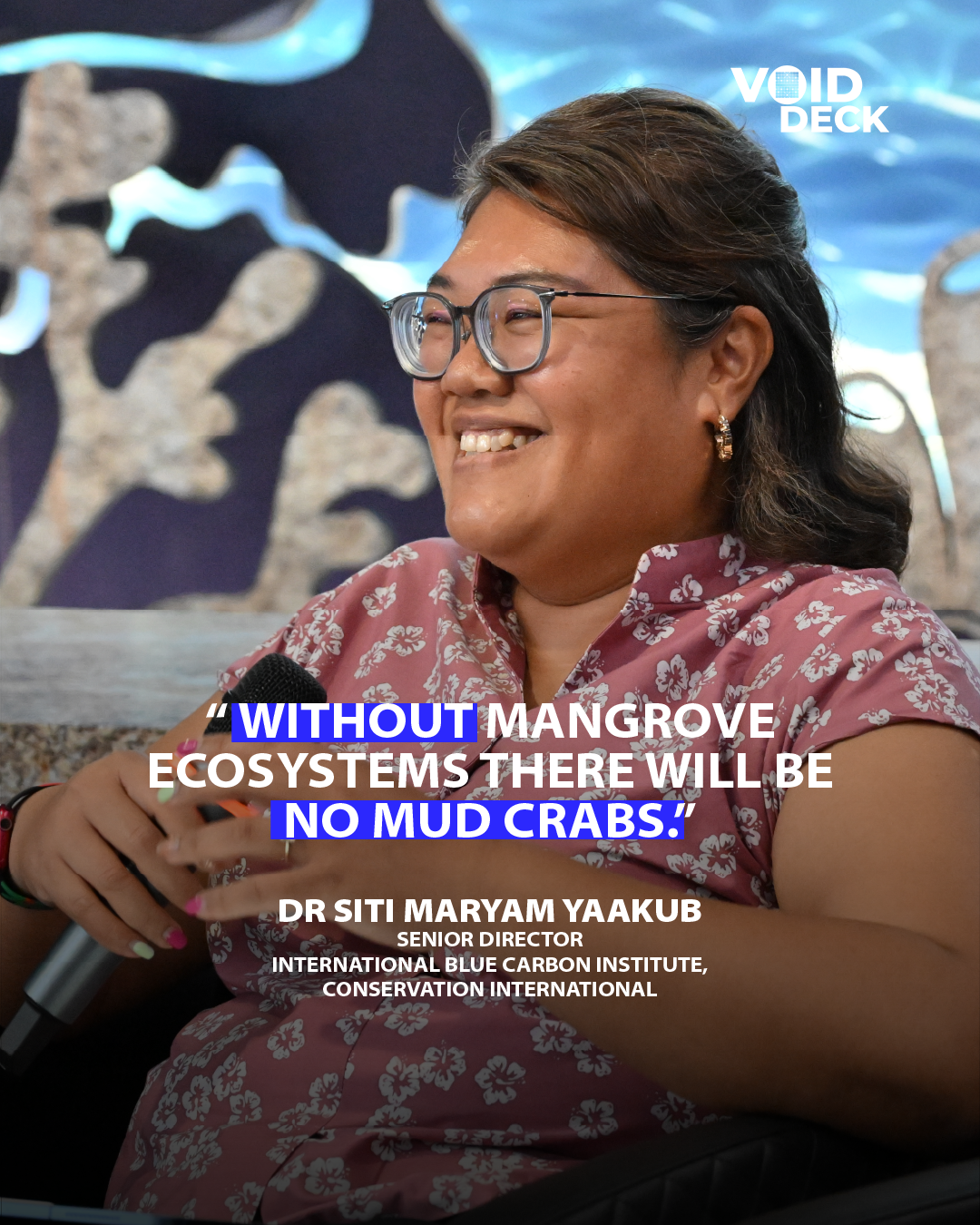
Our so-called national dish is the chili crab. and those crabs are mud crabs and they exist in mangrove ecosystems and without mangrove ecosystems there will be no mud crabs and then we will all be deprived of the national dish. So this is very important because we're pitting Singaporeans in the stomach and that's what really matters.
Kelly Latimer:
All right, Elia, let's head on to you. One Ocean is rooted, I've heard several times now that decades of research has gone into this. But the audience is... They're not going to want to step into a scientific report because, let's face it, the scientists will read the papers. But an average person is not going to sit there and try to digest all of this. So stepping into an immersive world like here at One Ocean is really important on so many fronts. How exactly did RideFX approach the transformation, taking all of that data, taking all of that knowledge, and creating such a readily, wonderful, multi-sensory experience that you can actually feel emotionally connected to. And I'll share my most emotional moment in a few short moments after you talk because I feel like I want to hear it from you first.
Elia Vermander:
Thank you for the kind words to start it. I became a parent a couple of years ago, and there's magic, of course, in parenting in general. But you can present a fact for a child, an adult, for anyone. It will evaporate or disappear. It doesn't stick. As soon as you tell a story, it stays with them for years and maybe even for their whole lives. So the magic is once upon a time, there was a coral reef… and so you draw them in through the classics, you draw them in through story, you draw them in through emotion and then the second factor we apply is into activities. You'll understand right away. When you enter, you will see these huge curtains as if you're stepping in front of the theater.
And the theater is where a story takes place. The story we're telling is the story of the ocean in all its assets and we could tell this story for thousands of years and still not finish it. The goal is for people to step inside a whole universe. And in this universe, they can feel different things. They can feel engaged, they can feel affected. Within the tara foundation there’s like a microplankton fan club and so we work with an original idea from them, turning them into superheroes and this is something that all kids can relate to. This is part of their world, part of what fascinates them, what attracts them. So you will see we built a gallery of superheroes and every superhero can explain their particular role, whether it's digesting carbon dioxide or helping to build structures. Likewise, how do you explain something as massive and majestic as the ocean currents?
There are neurological studies proving that with true interaction and true emotion, knowledge is absorbed. So that's basically our approach and we always start from the scientific data because that's the truth and it's very important to tell the truth. Then you work with people who are passionate about this and actually you let them tell the stories and our job is just to take them and then translate and make them accessible.
Kelly Latimer:
For a moment, I thought you were going to take away the bit that I found most impressive. When I walked through the Seven Wonders just now, you get the sense of scale. You're looking at all of these creatures. You walk in. We kind of have an idea because we go and see things. We know how big a jellyfish is. We know roughly how big the coral is. But then you start seeing some of the imagery of the whales swimming past you. And you're looking at it. My daughter and I were like, whoa, this is massive. But when we talked to the team, they’re like, it is only half the size.
It is only half of what is actually out there so you are already feeling awed – a sense of great wonder and awe by looking at these graphics and feeling like you're so close to them but actually it doesn't even touch the surface. But to get a glimpse of that scale as well – I feel that is something that you have never really experienced before.
Dr Siti, one ocean breaks global science to Singapore but it also intentionally brings the story back to Singapore, to our local waters. You had talked about how it'd be so close to our stomachs with our chili crab. Why does connecting global environmental issues to Singapore's marine microsystems matter so much? Because we understand when it comes to our stomachs, yeah, okay, we need to protect the ones near us. But everywhere else, does it really matter? I mean, we understand now the waterways are really important for shipping, for infrastructure, for oil. Inside the ocean, why does something that happened in the Arctic, for example, why would it matter to us and why do we need to care?
Dr Toh Tai Chong:
I think this exhibition brings together this key point that ecosystems and oceans are connected. Whatever happens in the Arctic will affect us. Sea level rise, for example. It's a very clear indication of how impacts will affect us. But as we try to communicate there, we often struggle to understand how this very big picture, a very distant concept, is related to Singapore. And I think the local segment for this particular exhibition is that particular feature to draw people in, to take action, to learn more about our own ecosystems first. Hopefully we can encourage people to start small, start local. In fact, Singapore's research in marine science has been here for decades, close to five decades now. A lot of people are working behind the scenes in one way or another. We have, in the exhibition, marine scientists like Lionel and Yan Xiang, who have been working in different ways to support Singapore’s marine ecosystem. And I think the key message here is that every single one can make a difference. And I think this particular segment aims to do that. And for us, I think it's one way of trying to reach out to different groups of people.
Dr Toh Tai Chong:
In 2017, two of us started Our Singapore Reefs. And that's really an effort to bring scuba divers to local waters and pick up trash. Very simple act, very simple action. And through that, we have environmental education. But never ever underestimate the impact of such ripples. Because as the nature of our work goes, we have a lot of dive professionals. And they started picking trash. And one thing that was really unexpected was that in one of the dives that we had with them overseas, purely leisure, recreational and we started seeing the dive instructor picking up trash from the waters of Bintan and the students started doing the same – putting it into their pocket and this is unseen or is rarely seen in the dive industry because most people are appreciating nature but most of them are not doing the action of picking up the litter. So can you imagine if you have just influenced 10 people and that 10 dive professionals are able to influence another hundred thousands more, their ripple effect is tremendous. So the idea here is we hope this exhibition will do that, connect people, connect issues, and present opportunities for people to work together.
Kelly Latimer:
Dr. Siti, what about you? Especially as someone who's literally just flown in from the other side of the planet.
Dr Siti Maryam Yaakub:
Thanks. So I was in the Caribbean last week. And the Caribbean has suffered a lot in terms of their coral reefs. They've lost most of their coral reefs. And it was very heartbreaking for me. I was there for the seagrass, but of course, these ecosystems are interconnected with each other. So it was very heartbreaking to see dead corals, right? And I think that Singaporeans can start appreciating what they have in our own quarters. So whether you go to Sentosa or when you go to Chek Jawa or Labrador, and see these ecosystems, connect with them – I think that's the important link. So when we're bringing it back to Singaporeans, we need to be familiar with what we have here in our country, in our waters, right? But what we have here also mirrors what our regional neighbors have. So when you go for holidays overseas and you see a coral reef in Indonesia or a seagrass meadow in the Philippines, you immediately connect that hey, we have that too, right? So they're key. It's this shared understanding of what the impacts and the threats are, because then you can say, OK, if Singapore's coral reefs, mangroves and seagrass ecosystems are affected by things like pollution, by sedimentation, by all of these other impacts, that are similarly happening in our neighboring countries. And it makes us care about not only what you have, but what’s beyond our borders. And I think this is very much reflected in the Singapore government and our sense on climate change. Singapore, if you guys don't know, is a huge leader in climate negotiations, right? We're taking steps to ensure that. Everyone is in on this collective action. We're very much years in that space in the climate negotiations at the UN talks. And I think that needs to trickle down to the population as well. So I think having this ecosystem, like going to this exhibition, for example, learning about what ecosystems there are in Singapore, what biodiversity there is, and then going out there into places in Singapore, like Chek Jawa, Labrador, and many others, and then going overseas and seeing the same ecosystems being affected by the same impacts, I think that really brings the message home that we're all in this together and that this is really one ocean, right? Whatever happens in other places affects us. It affects our food supply, it affects resilience. And I think that's a sort of underlying human message that is so powerful in exhibitions like this.
Kelly Latimer:
Incredible. Absolutely. I think what's also really important is making sure that we stay true to that information as well, right? Especially when you're trying to convey things in a more interactive, immersive storytelling way. So between Elia and Sébastien, I'd love to find out a bit more about that scientific accuracy and how emotional storytelling had to go hand in hand. How was that collaboration process like to make sure that it happened as truthfully as possible?
Elia Vermander:
Lots and lots of WhatsApp messages. The Tara Ocean Foundation is clearly the scientific part. I also think it's about being humble and open. There's a lot of different definitions today with the word ‘immersive’, from the very superficialistic, flashy, and then all the way to how immersive can be used through what we do, tell the story, and represent scientific facts. It's not always easy because you also want to have those nice images. I also want people to be taking pictures and sending it to their friends, but the priority is scientific impact so if there's anything in our images that's not correct then that's not the right way to tell the story.
It’s also a dialogue, not simply, right or wrong. The VR experience was a real challenge. We wanted to make something fun and we built a character, Yellow the tiny submarine, and he’s the one explaining to us about blue carbon. But you need to put in just enough scientific facts for it to carry meaning and not too much for them to just start playing around in the VR experience/. So that fine balance is what we managed to establish with the Tara Ocean Foundation.
Sébastien Ruiz:
Yes, Elia will send many, many mails, many WhatsApp, But first thing, we prioritise really precise scientific information. We have worked with many hundreds of scientists for 23 years. So we have a lot of data and a lot of information. And as we say, science is not an opinion, truth is not an opinion. It's really important to say that. So, when we work together, we come with many, many pieces of information, but all information are checked and verified deeper with scientists. It's really important for us. And after that, it's important to find a way to tell the story.
Kelly Latimer:
It's just remarkable that everything that we are going to see today and experience today is all facts. These are all things that are absolutely true. They are hard facts, but they are told to us in a way that's going to capture the attention of anyone who’s older than us, our age, or even the younger ones around us in a way that will hopefully spark more conversations around conservation.
But going down the line, I would love to know what is the one thing that you would like people to take away after they experience One Ocean, Every Action Ripples.
Sébastien Ruiz:
The most important thing is to think differently after this exhibition because involvement, commitment is really important and we can transform with advocacy because all actions are important.
Dr Siti Maryam Yaakub:
I think for me, it's for people to understand that every part of the ocean, from the ecosystems, in the physical pumps and all that, that's part of this larger climate infrastructure that is helping us regulate climate in the world, right, on this planet. But also that every action matters. That connection from what you see here in the exhibition to what we have in Singapore and what we have in the neighboring countries and globally, I think that's also a very important point. And then lastly, I think I want people to know that every action matters, right? So keeping yourself informed, contributing to the conservation of ecosystems, not just in Singapore, but also overseas. Being aware of your choices and how that affects the natural environment. I think that is something that I would like all to take away from us.
Dr Toh Tai Chong:
I think my hope for people who have gone through this entire experience would be that, one, they recognize that every single gift, talent, and connections that they have can be used for ocean conservation. Two, to really start small, start local, supporting local conservation efforts, being in sites or in nature-guided walks, or to just simply bring kids to the intertidal regions to let them know about what's in our backyard. And that's really my hope for this entire exhibition.
Elia Vermander:
For me, it's always the same answer, what do I want people to feel when leaving an exhibition? Wonder. I want to feel wonder, because wonder means if you're able to feel wonder, you're able to feel love. And if you feel love for the ocean, I believe that will ripple on further actions in everyday life.