
Scary sounds in the ocean
5 of the most unnerving sounds ever recorded in the ocean
Despite humans exploring the ocean for centuries, we've only explored around 5% of it. That means the vast majority of our oceans remain largely unknown. Over the years, scientists have recorded strange underwater sounds that left researchers puzzled for years.
Fortunately, many of these mysterious sounds have since been explained. Here are five of the scariest sounds ever recorded in the ocean, including three that remained unexplained for years and two animal calls that sound like they belong in a horror movie.
1. Biotwang
In 2014, researchers detected a strange sound in the Mariana Trench region that became known as Biotwang. The recording begins with a deep, low-frequency groan before ending with a metallic, high-pitched twang, giving it an almost science fiction-like quality.
For years, scientists were unable to identify its source. It wasn't until 2024 that researchers, publishing in Frontiers in Marine Science, confirmed that the sound was produced by Bryde's whales (opens in new tab). These baleen whales belong to the same rorqual family as blue whales and humpback whales and are commonly found in warm temperate and tropical waters of the Atlantic, Indian and Pacific Oceans.

2. Bio-Duck
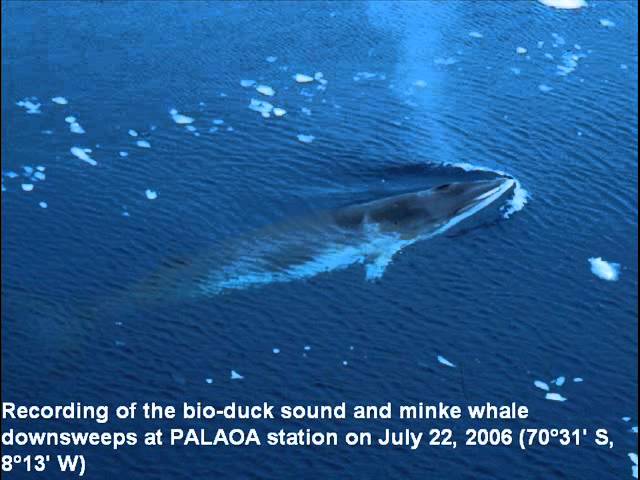
One of the ocean's longest-running mysteries was the bio-duck sound. First recorded in the 1960s in Antarctic waters and off the west coast of Australia, the sound consisted of a repetitive series of pulses with frequencies between 60 and 100 Hz, accompanied by harmonics reaching 1 kHz.
Its rhythmic, duck-like pattern puzzled researchers for decades. Finally, in 2014, scientists confirmed that the mysterious sound was made by Antarctic minke whales (opens in new tab). Despite being one of the smallest baleen whales, they produce one of the ocean's most distinctive and haunting underwater calls.
3. The Bloop
Perhaps the most famous unexplained ocean sound is the bloop (opens in new tab), recorded by the U.S. National Oceanic and Atmospheric Administration (NOAA) in 1997 in the South Pacific Ocean. The extremely powerful, ultra-low-frequency sound was so loud that it was detected by hydrophones over 5,000 kilometres apart.
Its enormous volume led to widespread speculation that it came from an unknown giant marine creature. However, in 2012, NOAA concluded that the sound was most likely caused by large Antarctic icebergs fracturing and cracking, a phenomenon known as an icequake. These massive ice movements generate low-frequency sounds capable of travelling extraordinary distances through seawater.
4. Male Bearded Seal
Not every terrifying sound in the ocean is a mystery. During the breeding season, male bearded seals produce long, eerie trills, whistles and moans underwater to attract females and defend their territory.
Their calls can last for several minutes and echo through Arctic waters, sounding more like something from a science-fiction film than a marine mammal. Bearded seals are found throughout the Arctic and Subarctic regions, including Alaska, Canada, Greenland, Norway and Russia.

5. Oyster Toadfish
The oyster toadfish (opens in new tab) may not look intimidating, but it produces surprisingly loud underwater sounds. Males emit deep, foghorn-like "boatwhistle" calls to attract mates and defend nesting sites during the breeding season.
These powerful grunts and hums are created by rapidly vibrating muscles attached to the fish's swim bladder, making them one of the loudest fish relative to their size. Oyster toadfish are commonly found along the Atlantic coast of North America, from Maine to Florida, especially in shallow coastal waters.
Although these sounds may seem terrifying at first, they remind us just how much of the ocean remains unexplored. What once sounded like monsters hiding beneath the waves often turns out to be whales communicating, seals searching for mates, or even glaciers breaking apart.
